Aida 14 vs 16 vs 18 Count: Which Cross Stitch Fabric Should You Choose?
The main difference between 14, 16, and 18-count Aida is the size of the fabric squares. Fourteen-count Aida has the largest holes and creates the largest finished design. Sixteen count creates a slightly smaller and finer result, while 18 count produces the smallest stitches and most compact design.
For most beginners and Christmas stocking projects, 14-count Aida is the best choice. Sixteen count is ideal when you want finer detail without making the fabric extremely difficult to see. Eighteen count works well for experienced stitchers who prefer small, detailed designs.
The right choice depends on your eyesight, experience, preferred finished size, thread coverage, and the type of project you want to make.
What Does Aida Count Mean?
Aida count tells you how many cross stitch squares fit into one inch of fabric.
For example:
- 14-count Aida has 14 squares per inch.
- 16-count Aida has 16 squares per inch.
- 18-count Aida has 18 squares per inch.
The higher the fabric count, the smaller each individual square becomes.
Therefore:
- 14 count creates the largest stitches.
- 16 count creates medium-sized stitches.
- 18 count creates the smallest stitches.
This is one of the most important facts to understand when choosing cross stitch fabric.
A higher number does not mean a larger finished project. It means that more stitches fit into every inch, so the same pattern becomes smaller.
Aida 14 vs 16 vs 18: Quick Comparison
| Feature | 14-count Aida | 16-count Aida | 18-count Aida |
|---|---|---|---|
| Squares per inch | 14 | 16 | 18 |
| Stitch size | Largest | Medium | Smallest |
| Finished design | Largest | Smaller | Most compact |
| Hole visibility | Easiest to see | Moderately small | Fine and more difficult to see |
| Common skill level | Beginner to advanced | Intermediate | Intermediate to advanced |
| Common needle size | Size 24 | Size 26 | Size 28 |
| Common floss starting point | 2 strands | 2 strands | 1–2 strands |
| Best for | Beginners, stockings and general projects | Finer detail and medium-size designs | Small, detailed projects |
| Stitching comfort | Most comfortable | Moderate | Requires more concentration |
These are general starting points. Always follow the fabric, needle, and floss recommendations included with your pattern.
Is 14-Count Aida Bigger Than 16 or 18 Count?
The physical fabric may be sold in any cut size, but the stitch squares on 14-count Aida are larger.
This means that a pattern stitched on 14 count will be physically larger than the same pattern stitched on 16 or 18 count.
For example, imagine a pattern that is 140 stitches wide.
- On 14-count Aida: 140 ÷ 14 = 10 inches wide.
- On 16-count Aida: 140 ÷ 16 = 8.75 inches wide.
- On 18-count Aida: 140 ÷ 18 = approximately 7.8 inches wide.
The pattern still contains 140 stitches across. Only the physical size changes.
How Aida Count Changes the Finished Design Size
Use this formula:
Number of stitches ÷ fabric count = finished size in inches
To convert inches to centimeters:
Inches × 2.54 = centimeters
Consider a Christmas stocking pattern measuring 132 stitches wide and 249 stitches high.
| Fabric count | Approximate width | Approximate height |
|---|---|---|
| 14-count Aida | 9.4 in / 24 cm | 17.8 in / 45.2 cm |
| 16-count Aida | 8.25 in / 21 cm | 15.6 in / 39.5 cm |
| 18-count Aida | 7.3 in / 18.6 cm | 13.8 in / 35.1 cm |
The same chart produces three noticeably different finished sizes.
These measurements describe the stitched design area. You must still add enough fabric for margins, framing, seam allowance, or final assembly.
Use the free Cross Stitch Fabric Calculator to calculate the finished design and required fabric cut before purchasing your materials.
What Is 14-Count Aida Best For?
Fourteen-count Aida is the most practical choice for many cross stitch projects.
It is especially suitable for:
- complete beginners;
- large Christmas stockings;
- stamped cross stitch;
- counted cross stitch;
- children and teenagers learning the craft;
- stitchers who want clearly visible holes;
- projects with lettering or personalization;
- designs that need to remain a practical finished size.
Advantages of 14-Count Aida
- The holes are easier to see.
- The fabric is comfortable to hold and stitch.
- Mistakes are easier to identify and correct.
- Common tapestry needles pass through the holes comfortably.
- Two strands of floss usually provide good coverage.
- The finished design is large enough to display clearly.
- It works well for long projects containing thousands of stitches.
Disadvantages of 14-Count Aida
- The finished design is larger than on 16 or 18 count.
- More fabric is required.
- Larger stitches may use more floss.
- Very detailed patterns may look slightly less refined than on finer fabric.
- Dark fabric may show through between stitches if the thread coverage is too light.
For most stitchers, these disadvantages are minor compared with the comfort and versatility of the fabric.
Why We Use 14-Count Aida for Christmas Stockings
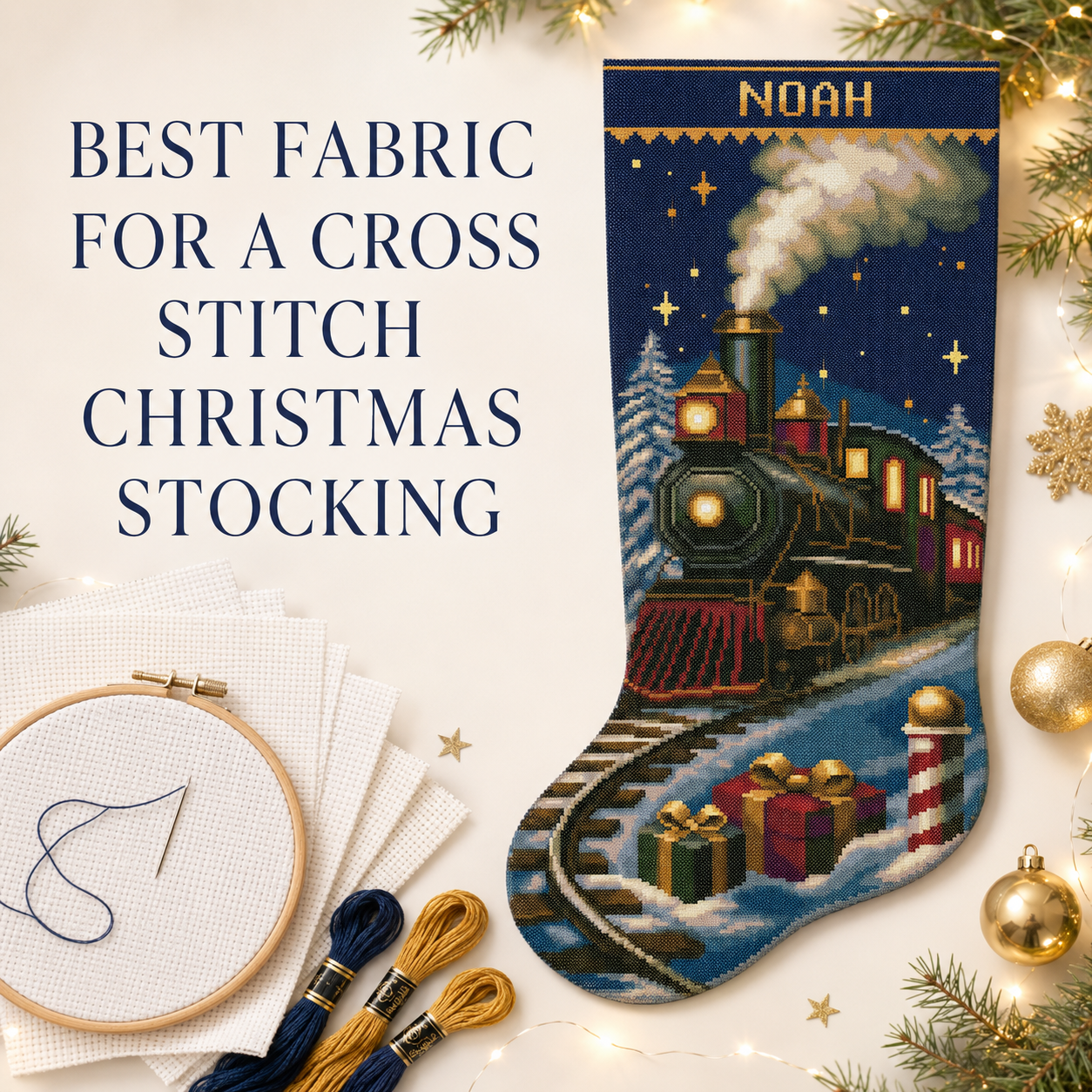
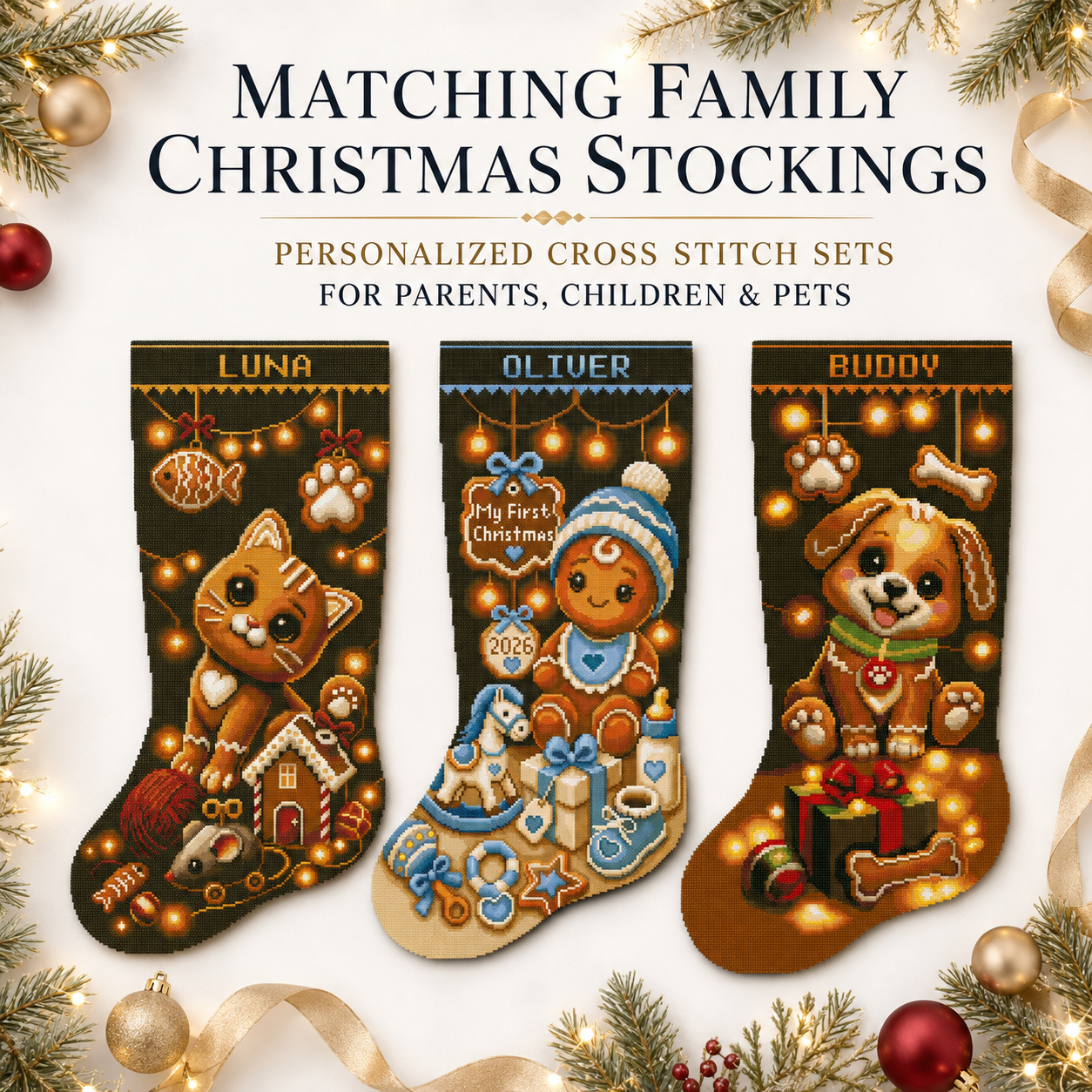
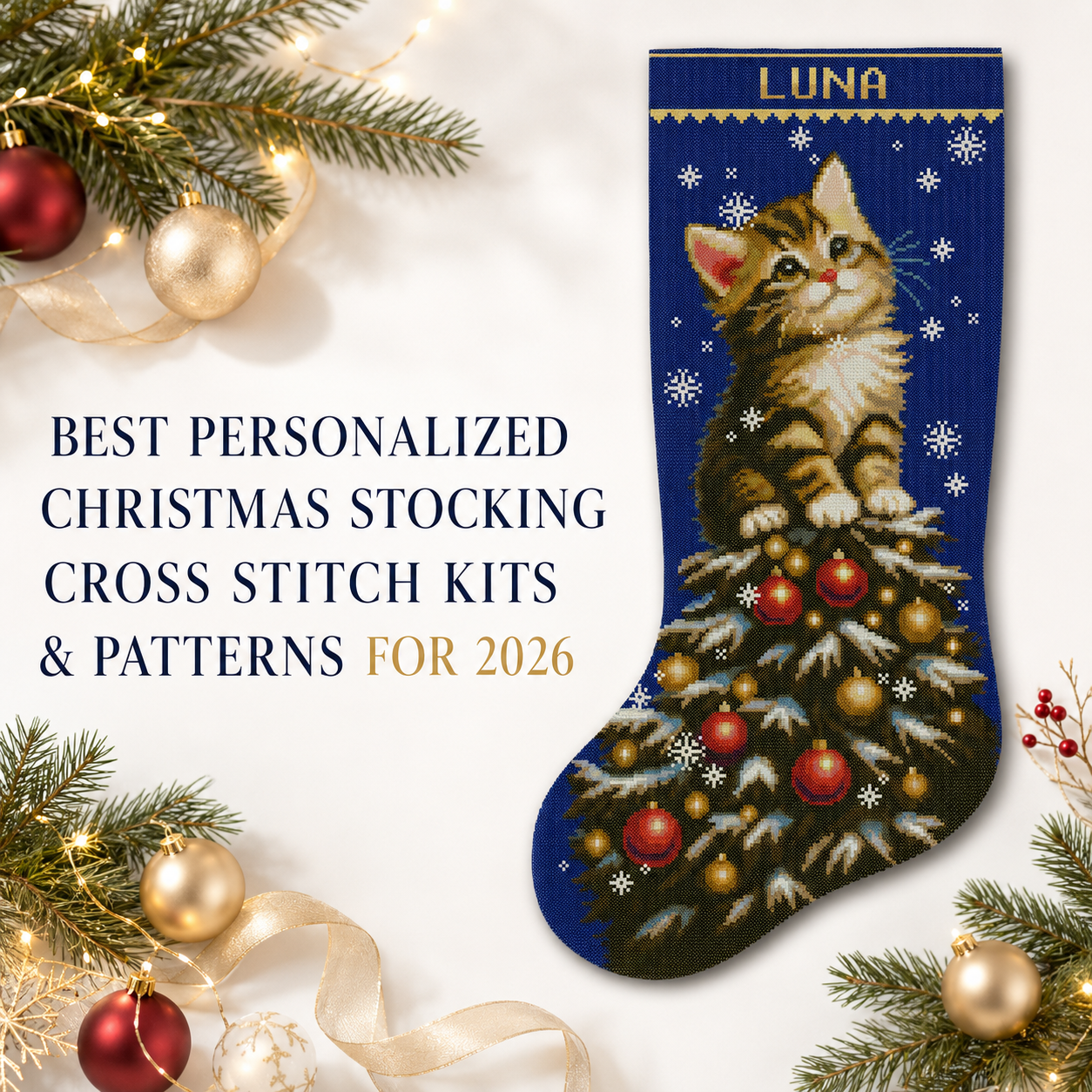
A full-size Christmas stocking needs to be large enough to display and use while still showing clear details in faces, snowflakes, lights, gifts, and personalized names.
Fourteen-count Aida provides this balance.
At CrossStitchStyleArte, our 2-in-1 Christmas stocking kits include:
- pre-printed 14-count Aida for stamped cross stitch;
- blank white 14-count Aida for counted cross stitch.
Both fabric options create the same design and finished size. The stitcher chooses the method that feels most comfortable.
The stamped option is easier for beginners because the symbols are printed directly on the fabric. The counted option is suitable for stitchers who prefer following a traditional chart.
Read our complete guide to the best fabric for a cross stitch Christmas stocking for information about backing, lining, seam allowance, and stocking construction.
What Is 16-Count Aida Best For?
Sixteen-count Aida is a good middle option between comfortable 14 count and fine 18 count.
It is suitable for:
- stitchers with some counted cross stitch experience;
- projects that need slightly finer detail;
- patterns that are too large on 14 count;
- framed designs with limited display space;
- stitchers who can comfortably see smaller holes;
- projects where a compact result is preferred.
Advantages of 16-Count Aida
- It creates finer details than 14 count.
- The finished design is smaller.
- Two strands of floss often provide good coverage.
- It is still easier to see than 18 count.
- It can make curves and diagonal lines appear smoother.
- It works well for samplers, portraits, decorative pictures, and smaller stockings.
Disadvantages of 16-Count Aida
- The holes are smaller and require more concentration.
- The project may feel slower for beginners.
- It is easier to place a stitch in the wrong square.
- Dark 16-count fabric can be tiring for the eyes.
- The smaller finished size may not be suitable for a functional Christmas stocking.
Sixteen count is often a good choice for stitchers who find 14 count too large but are not ready to work on 18 count.
What Is 18-Count Aida Best For?
Eighteen-count Aida produces small, fine stitches and a compact finished design.
It is best for:
- experienced stitchers;
- detailed patterns;
- small framed projects;
- ornaments;
- designs with many subtle color changes;
- projects where space is limited;
- stitchers who enjoy fine, precise work.
Advantages of 18-Count Aida
- It creates a refined finished appearance.
- Details can look smoother.
- The final project is significantly smaller.
- Less physical fabric is needed for the same pattern.
- It works well for small decorations and detailed artwork.
Disadvantages of 18-Count Aida
- The holes are more difficult to see.
- It can cause eye strain during long stitching sessions.
- A bright lamp or magnifier may be necessary.
- Mistakes may be harder to find.
- The fabric can be frustrating for a complete beginner.
- The finished project may be much smaller than expected.
- It may not produce a practical full-size Christmas stocking.
Eighteen count is not automatically “better” than 14 or 16 count. It is simply finer.
The best fabric is the one that gives you the size, appearance, and stitching comfort you need.
Which Aida Count Is Best for Beginners?
Fourteen-count Aida is the best choice for most beginners.
The squares are large enough to see clearly, but the finished stitches still look neat and detailed.
A beginner can more easily learn how to:
- find the center of the fabric;
- count squares;
- follow chart symbols;
- maintain consistent stitch direction;
- control thread tension;
- correct mistakes;
- secure thread ends;
- add backstitch.
Starting on fabric that is too fine can make a first project unnecessarily difficult.
If 14-count holes are still difficult to see, 11-count Aida may be more comfortable. However, remember that the finished design will be much larger.
Our detailed 11 Count vs 14 Count Aida comparison explains the difference between these two beginner-friendly options.
Which Aida Count Gives the Best Detail?
Eighteen count usually provides the finest appearance because the stitches are smaller.
However, fabric count is not the only factor affecting detail.
The final result also depends on:
- the quality of the pattern;
- the number of colors;
- backstitch;
- fractional stitches;
- consistent stitch direction;
- thread coverage;
- fabric color;
- lighting;
- stitching tension.
A poorly prepared pattern will not become beautiful simply because it is stitched on 18 count.
Similarly, a well-designed pattern can look detailed and professional on 14-count Aida.
For many Christmas stocking designs, 14 count provides more than enough detail while producing a practical finished size.
Does Fabric Count Affect Thread Usage?
Yes. Fabric count affects the physical size of each stitch.
A stitch on 14-count Aida is larger than a stitch on 18-count Aida. If the pattern contains the same number of stitches and uses the same number of strands, larger stitches generally require more thread.
However, total floss consumption also depends on:
- the number of strands;
- stitching tension;
- thread-tail length;
- starting and finishing method;
- pattern complexity;
- long thread carries;
- mistakes and repeated stitching;
- backstitch and fractional stitches.
The smaller stitches of higher-count fabric may use less length per stitch, but using additional strands for coverage can change the final calculation.
Use the Cross Stitch Thread Calculator instead of guessing. Enter the fabric count, total stitches, number of strands, and desired safety allowance.
How Many Strands Should You Use?
There is no single strand rule that works for every pattern and fabric color.
A practical starting point is:
| Fabric count | Common starting point for full crosses |
|---|---|
| 14-count Aida | 2 strands |
| 16-count Aida | 2 strands |
| 18-count Aida | 1–2 strands |
Some stitchers prefer three strands on 14 count for fuller coverage, especially when using light floss on dark fabric.
However, additional strands:
- use more embroidery floss;
- create thicker stitches;
- can make the needle harder to pull through;
- may create bulky thread ends on the back.
Always follow the pattern instructions first. If you are unsure, stitch a small test area on spare fabric.
Look at the sample in natural light and decide whether you are satisfied with the coverage before beginning the complete project.
Which Needle Size Should You Use?
The tapestry needle should pass through the fabric holes comfortably without stretching them.
A common starting guide is:
| Aida count | Common tapestry needle |
|---|---|
| 14 count | Size 24 |
| 16 count | Size 26 |
| 18 count | Size 28 |
A tapestry needle has a blunt tip that passes between the fabric threads instead of piercing them.
The needle eye must be large enough for the selected number of floss strands, but the needle should not force the fabric holes open.
These recommendations are not absolute. Needle brands, thread types, and personal preferences vary.
Does Higher Fabric Count Take Longer to Stitch?
The pattern contains the same number of stitches regardless of fabric count.
A 20,000-stitch pattern remains a 20,000-stitch pattern on 14, 16, or 18 count.
However, higher-count fabric may feel slower because:
- the holes are smaller;
- you may need stronger lighting;
- accurate placement requires more concentration;
- threading a smaller needle may take longer;
- mistakes can be harder to see;
- the fabric may require magnification.
An experienced stitcher who enjoys fine fabric may not notice a significant difference. A beginner may stitch much more slowly on 18 count than on 14 count.
Comfort and accuracy are more important than choosing the finest possible fabric.
Can You Use the Same Pattern on 14, 16 and 18 Count?
Yes, most counted cross stitch charts can be used on different Aida counts.
The chart symbols, stitch count, and DMC colors remain the same.
You need to recalculate:
- finished dimensions;
- fabric cut size;
- margins;
- thread requirements;
- needle size;
- floss coverage;
- framing or finishing materials.
Use the Fabric Calculator before purchasing the fabric.
If the design will become a Christmas stocking, also calculate:
- backing fabric;
- lining fabric;
- seam allowance;
- hanging-loop placement;
- available space for the personalized name.
Do not substitute a different fabric count in a stamped cross stitch kit. The printed design is already aligned with the grid of the supplied fabric.
Which Aida Count Is Best for a Christmas Stocking?
For most Christmas stockings, choose 14-count Aida.
It creates:
- a practical full-size stocking;
- visible and comfortable holes;
- clear details;
- enough space for a personalized name;
- a manageable project for beginners;
- reliable results during sewing and finishing.
Choose 16 count if you intentionally want a smaller decorative stocking and are comfortable with finer fabric.
Choose 18 count only if you want a compact, detailed stocking and understand that the final result will be considerably smaller.
The most detailed fabric is not always the best fabric for the final purpose.
Which Aida Count Is Best for an Ornament?
For small Christmas ornaments, 16 or 18-count Aida can work very well.
The higher count helps keep the finished ornament compact while preserving the complete pattern.
Fourteen count may also be appropriate for:
- beginner ornaments;
- children’s projects;
- simple designs;
- ornaments intended to be large and easy to see.
Calculate the finished dimensions before choosing the fabric.
Which Aida Count Is Best for Framing?
All three counts can be framed successfully.
Choose:
- 14 count for a larger picture and comfortable stitching;
- 16 count for a balance of size and fine detail;
- 18 count for compact, detailed artwork.
Remember to add enough margin around the design for mounting and framing.
Do not cut fabric to the exact stitched dimensions.
What About Evenweave and Linen?
Aida is not the only cross stitch fabric.
Evenweave and linen are commonly stitched over two fabric threads.
The following equivalents create approximately the same stitch sizes:
| Aida | Evenweave or linen stitched over two |
|---|---|
| 14-count Aida | 28-count evenweave |
| 16-count Aida | 32-count evenweave |
| 18-count Aida | 36-count evenweave |
Evenweave can be helpful for fractional stitches and delicate lettering. Linen gives projects a traditional, heirloom appearance.
However, both require more careful counting than Aida.
Read Aida vs Evenweave before changing the fabric recommended in your pattern.
How to Choose the Right Aida Count
Ask yourself these questions before buying fabric.
How Large Should the Finished Project Be?
Calculate the finished size on every fabric count you are considering.
Can You See the Holes Comfortably?
Do not choose fabric that causes eye strain after a few minutes.
Are You a Beginner?
Start with 14 count unless you specifically need larger holes.
Does the Project Need to Be Functional?
A Christmas stocking must be large enough to display and hold gifts. A framed picture or ornament can be much smaller.
How Detailed Is the Pattern?
A fine pattern may benefit from 16 or 18 count, but a well-designed chart can still look excellent on 14 count.
How Many Hours Will You Stitch?
Comfort becomes very important during a large project containing thousands of stitches.
What Does the Pattern Recommend?
The designer’s recommendation is usually the safest starting point.
Common Aida Count Mistakes
Thinking 18 Count Creates a Larger Design
It creates a smaller design because more stitches fit into each inch.
Choosing Fabric Without Calculating the Finished Size
A small change in fabric count can significantly change a large pattern.
Assuming Finer Fabric Is Always Better
Fine fabric may look beautiful, but it is not better if it causes eye strain or produces the wrong finished size.
Using the Same Needle for Every Count
A large needle can stretch the holes of fine fabric. A very small needle may be uncomfortable with several floss strands.
Changing Count on Stamped Fabric
The printed pattern is prepared specifically for the supplied fabric grid. Do not replace it with a different count.
Forgetting About Thread Coverage
Test the number of strands before beginning the complete project.
Cutting Fabric to the Exact Design Size
Always add enough margin for stitching, framing, or sewing.
Frequently Asked Questions
Is 14 or 16-count Aida better?
Fourteen count is better for beginners, large projects, and full-size Christmas stockings. Sixteen count is better when you want a slightly smaller result and finer details.
Is 16 or 18-count Aida easier?
Sixteen count is generally easier because the holes are larger. Eighteen count requires more precise stitching and may need better lighting or magnification.
Does 18-count Aida make a pattern smaller?
Yes. The same pattern will be smaller on 18 count than on 14 or 16 count.
Can beginners use 18-count Aida?
They can, but it is not usually the most comfortable first choice. Fourteen count is easier to see and learn on.
What is the best Aida count for a Christmas stocking?
Fourteen-count Aida is the best choice for most Christmas stockings because it creates a practical size and remains comfortable to stitch.
Can I use a 14-count pattern on 16-count Aida?
Yes, if it is a counted cross stitch chart. The design will be smaller, so recalculate the dimensions and fabric requirements.
Does Aida count change the number of stitches?
No. The chart contains the same number of stitches. Only their physical size changes.
Which Aida count uses the most floss?
If the stitch count and number of strands are the same, lower-count Aida generally uses more floss because each stitch is physically larger.
What needle should I use for 14, 16 and 18 count?
A practical starting guide is size 24 for 14 count, size 26 for 16 count, and size 28 for 18 count.
Final Recommendation
Choose 14-count Aida if you are a beginner, want comfortable stitching, or are making a full-size Christmas stocking.
Choose 16-count Aida if you want a slightly smaller design with finer detail and can comfortably see the holes.
Choose 18-count Aida if you are an experienced stitcher creating a compact, detailed project.
Do not select fabric only because one count appears more professional than another. Calculate the finished size, consider the final purpose, and choose the fabric you can stitch comfortably.
The best Aida count is the one that helps you enjoy the process and create a finished project that is the right size for its intended use.