Cross stitch may look simple: two diagonal stitches cross to form an X. But this small stitch has travelled through centuries, countries and generations.
It has been used to decorate clothing, teach children, record family names and create meaningful gifts. Today, the same basic stitch appears in modern wall art, digital patterns and personalized Christmas stockings.
Let’s explore the history of cross stitch, how the craft changed and why people still enjoy it today.
Where Did Cross Stitch Begin?
There is no single confirmed place or date where cross stitch was invented.
People in different parts of the world discovered that two crossed stitches could create strong lines, geometric patterns and detailed pictures. Because fabric and thread naturally decay, many early examples have not survived.
The Victoria and Albert Museum describes cross stitch as one of the oldest and most recognizable embroidery techniques and mentions an early surviving example dating from around AD 850. The Royal School of Needlework also documents medieval cross stitch worked with silk on cotton evenweave fabric in Lebanon.
These surviving objects show that crossed stitches were used centuries ago. However, they do not prove that cross stitch was invented in one particular country or during one exact period. Victoria and Albert Museum, Royal School of Needlework Stitch Bank.
Why Cross Stitch Was Easy to Share
Cross stitch works especially well on fabric with an even structure.
A stitcher can count the same number of fabric threads horizontally and vertically to create evenly sized X-shaped stitches. This makes it possible to repeat a design without drawing the complete picture on the fabric.
A pattern could therefore be:
- copied onto paper;
- stitched from a sample;
- shared between families;
- adapted to a different fabric;
- repeated on clothing or household linen.
The method was practical long before modern printed charts existed.
Pattern Books and Counted Embroidery
During the sixteenth and seventeenth centuries, printed pattern books helped embroidery designs travel between countries.
The books often contained geometric borders, flowers, animals and decorative motifs. Stitchers could copy these designs onto linen by counting the fabric threads.
Not every design was made entirely with cross stitch. Historical embroidery frequently combined cross stitch with double running stitch, satin stitch, chain stitch and other techniques.
This is an important difference between historical needlework and many modern cross stitch patterns. Today, a chart may be built mainly from full crosses, with backstitch and French knots added only for detail.
If you are learning these techniques, read our guide to different cross stitch techniques.
The Rise of Embroidery Samplers
A sampler was originally a place to record and practise stitches.
Instead of beginning a completely new design every time, a stitcher could keep useful borders, alphabets and motifs together on one piece of fabric. The sampler became a personal reference library made with needle and thread.
Early band samplers were usually long and narrow. They contained horizontal rows of different patterns.
A British sampler made by Mary Pots in 1648 shows how samplers could be both practical and decorative. It includes several embroidery techniques on a linen ground. The Metropolitan Museum of Art.
Over time, samplers became more elaborate. They might include:
- alphabets and numbers;
- names and initials;
- dates;
- flowers and animals;
- religious verses;
- family information;
- decorative borders;
- buildings or local scenes.
Cross Stitch as Part of Education
During the eighteenth and nineteenth centuries, sampler making was frequently connected with education.
Children used needlework to practise sewing, but a sampler could also help them learn:
- letters and spelling;
- numbers and arithmetic;
- geography;
- religious texts;
- patience and accuracy.
An American sampler stitched in 1840 by eight-year-old Mary Elizabeth Morse includes alphabets, numbers and a lesson about the history and geography of New York City. It shows that embroidery could teach more than sewing. The Metropolitan Museum of Art.
Historical samplers were not perfectly identical. Their materials, motifs and purposes depended on the maker’s country, school, family and available supplies.
Some were carefully planned display pieces. Others were simple exercises made by children who were still learning.
Names, Dates and Personal Stories
One reason historical samplers remain valuable is that they preserve information about ordinary people.
A sampler may contain a child’s name, age, home, school or completion date. In some cases, it is one of the few surviving records of that person’s life.
Cross stitch therefore became more than decoration. It could preserve identity and memory.
This tradition continues today. Stitchers still add:
- a child’s name;
- a wedding date;
- a baby’s birth year;
- a family surname;
- a first Christmas date;
- a personal message.
A personalized cross stitch project connects a modern maker with a tradition that is hundreds of years old.
How Cross Stitch Spread Between Countries
Cross stitch did not develop in exactly the same way everywhere.
Patterns travelled through migration, trade, schools, printed books and family traditions. Stitchers adapted them to local fabrics, colors and symbols.
For example, the Victoria and Albert Museum documents how crossed stitches became highly popular in nineteenth-century Mexican embroidery. Makers used counted stitches to create animals, birds, plants and symbols connected with local identity and national history. Victoria and Albert Museum.
This reminds us that cross stitch is not simply one European tradition. It has been interpreted by many communities and cultures.
The Nineteenth-Century Cross Stitch Boom
During the nineteenth century, cross stitch became more accessible.
Fabric and thread production improved, printed designs circulated more widely and shops could supply materials to a growing number of stitchers.
Cross stitch was used for:
- decorative samplers;
- cushions;
- household linen;
- clothing details;
- fire screens;
- bell pulls;
- small framed pictures;
- gifts and keepsakes.
However, it would be inaccurate to say that all cross stitch suddenly became a mass-produced hobby. Many stitchers still learned at home, reused family motifs and worked with locally available materials.
Cross Stitch in the Twentieth Century
During the twentieth century, commercial patterns and complete embroidery kits changed how many people started a project.
Instead of collecting the fabric, chart and every thread separately, a stitcher could buy one kit containing most or all required materials.
Modern kits made the craft easier for beginners because they could include:
- pre-cut fabric;
- sorted embroidery floss;
- needles;
- a printed chart;
- a color key;
- basic instructions.
Stamped cross stitch also became popular. In this method, the symbols or colors are printed directly on the fabric. The stitcher follows the printed design and washes the markings away after completing the project.
Counted cross stitch remained popular with people who preferred working from a separate chart.
Not sure which method is right for you? Read our beginner guide to using a stamped cross stitch kit.
The Digital Cross Stitch Revolution
The internet changed cross stitch again.
A pattern no longer had to be printed and physically shipped. Designers could create a PDF chart and make it available for immediate download.
Digital patterns offer several advantages:
- instant access;
- easy storage;
- the ability to print another working copy;
- zooming on a phone or tablet;
- access to independent designers around the world;
- a much wider selection of themes.
Modern designs are no longer limited to traditional alphabets and flowers. They may feature animals, family portraits, humor, fantasy, Christmas scenes or personalized names.
Explore our modern cross stitch patterns if you would like to begin a project of your own.
How Technology Helps Modern Stitchers
Today’s stitchers can use online tools to plan a project before making the first stitch.
For example, you can:
- calculate the required fabric size;
- estimate how much embroidery floss you need;
- plan the project around a deadline;
- center a personalized name;
- download a printable stitching schedule.
Useful free tools:
- Cross Stitch Fabric Calculator
- Cross Stitch Thread Calculator
- Cross Stitch Time Calculator and Planner
- Stocking Name Centering Calculator
The tools are modern, but the goal remains familiar: turning thread and fabric into something meaningful.
Traditional Cross Stitch vs Modern Cross Stitch
The basic X-shaped stitch has not changed. What has changed is how patterns are created, distributed and used.
Traditional cross stitch often featured:
- alphabets and numbers;
- geometric borders;
- flowers and animals;
- religious or moral texts;
- family names and dates;
- limited locally available colors.
Modern cross stitch may include:
- detailed shading;
- large color palettes;
- digital PDF charts;
- stamped fabric;
- personalized names;
- contemporary themes;
- project-planning tools;
- patterns viewed on electronic devices.
Neither approach is better. Many modern projects combine traditional stitching with current design and technology.
Why Is Cross Stitch Still Popular?
Cross stitch survives because it is simple to begin but offers room to improve.
A beginner can learn the basic stitch quickly. An experienced stitcher can create a large and highly detailed design using the same basic X-shaped structure.
People also choose cross stitch because it can be:
- relaxing and repetitive;
- creative without requiring drawing skills;
- easy to pause and continue later;
- personalized for a particular person;
- turned into a meaningful handmade gift;
- preserved as a family keepsake.
A finished piece records time and care in a way that a factory-made decoration cannot reproduce.
Create a Modern Family Keepsake
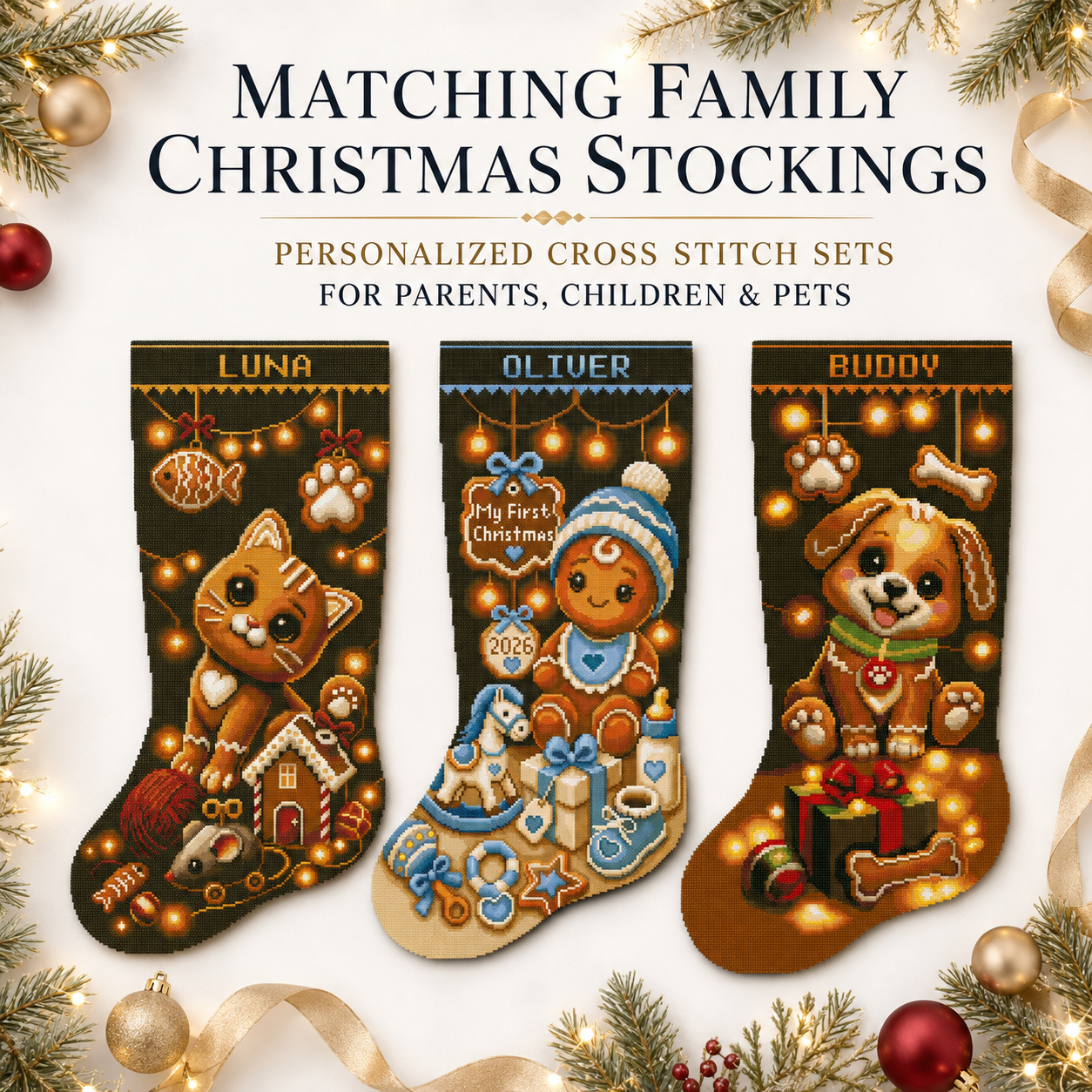
One of the best examples of cross stitch’s continued evolution is the personalized Christmas stocking.
It combines several historical traditions:
- counted embroidery;
- names and dates;
- decorative household textiles;
- handmade family gifts;
- designs intended to last for generations.
Our personalized cross stitch Christmas stocking kits include the materials required to create a full-size stocking. Beginners can choose stamped fabric, while traditional stitchers can work from counted Aida.
You can also explore our digital Christmas stocking pattern set for an instantly downloadable project.
The Future of Cross Stitch
Cross stitch continues to change without losing its basic structure.
Digital charts, pattern-design software and online communities make the craft easier to access. Personalization allows makers to change names, dates and colors. Modern tools help calculate materials and organize stitching time.
But the most important part remains unchanged.
A stitcher still passes a needle through fabric, makes one small X and then adds another. Slowly, the separate stitches become a picture.
That connection between simple actions and a lasting result is why cross stitch has survived for centuries—and why it is likely to remain meaningful for generations to come.
Frequently Asked Questions About Cross Stitch History
How old is cross stitch?
Crossed embroidery stitches have existed for many centuries. Surviving museum examples date from the medieval period and earlier, but there is no confirmed single date or place where modern counted cross stitch was invented.
What were embroidery samplers used for?
Samplers were used to practise and record stitches, borders, alphabets and motifs. They were also used to teach sewing, letters, numbers and other school subjects.
Was cross stitch only practised in Europe?
No. Crossed stitches appear in embroidery traditions from different parts of the world. Designs and uses varied according to local materials, culture and history.
When did cross stitch kits become popular?
Commercial patterns and kits became increasingly common during the twentieth century. Kits made the craft easier to begin by placing fabric, thread, needles and instructions in one package.
Is modern cross stitch different from traditional cross stitch?
The basic stitch remains the same. Modern cross stitch uses new tools, digital charts, wider color palettes and contemporary designs, but it still relies on counted X-shaped stitches.