Best Fabric for a Cross Stitch Christmas Stocking: Aida Count, Size and Finishing Guide
For most cross stitch Christmas stockings, 14-count Aida is the best fabric. It provides an excellent balance between visible holes, comfortable stitching, clear details, reliable coverage, and a practical finished stocking size. It is suitable for beginners while still producing a polished result for experienced stitchers.
However, the best choice also depends on the pattern, your eyesight, your preferred stitching method, and the size you want the finished stocking to be.
This guide explains how Aida count changes the size and appearance of a Christmas stocking, when to consider 11, 16, or 18-count fabric, and which fabrics work best for the backing and lining.
What Is the Best Fabric for a Cross Stitch Christmas Stocking?
The best all-around choice is good-quality cotton 14-count Aida.
It works especially well for Christmas stockings because it:
- has clearly defined holes;
- is comfortable for beginners;
- provides enough detail for faces, animals, lettering, and decorations;
- works well with common tapestry needles;
- creates a practical full-size stocking;
- holds its shape during stitching and sewing;
- can be used for stamped or counted cross stitch;
- is widely available in different colors.
At CrossStitchStyleArte, we use 14-count Aida for our Christmas stocking designs because it provides a reliable combination of comfort, detail, and finished size.
Our 2-in-1 Christmas stocking kits include both pre-printed 14-count Aida for stamped cross stitch and blank white 14-count Aida for traditional counted cross stitch. The stitcher can choose the method they prefer while creating the same finished design.
What Does Aida Count Mean?
Aida count tells you how many cross stitches fit into one inch of fabric.
For example:
- 11-count Aida has 11 stitch squares per inch.
- 14-count Aida has 14 stitch squares per inch.
- 16-count Aida has 16 stitch squares per inch.
- 18-count Aida has 18 stitch squares per inch.
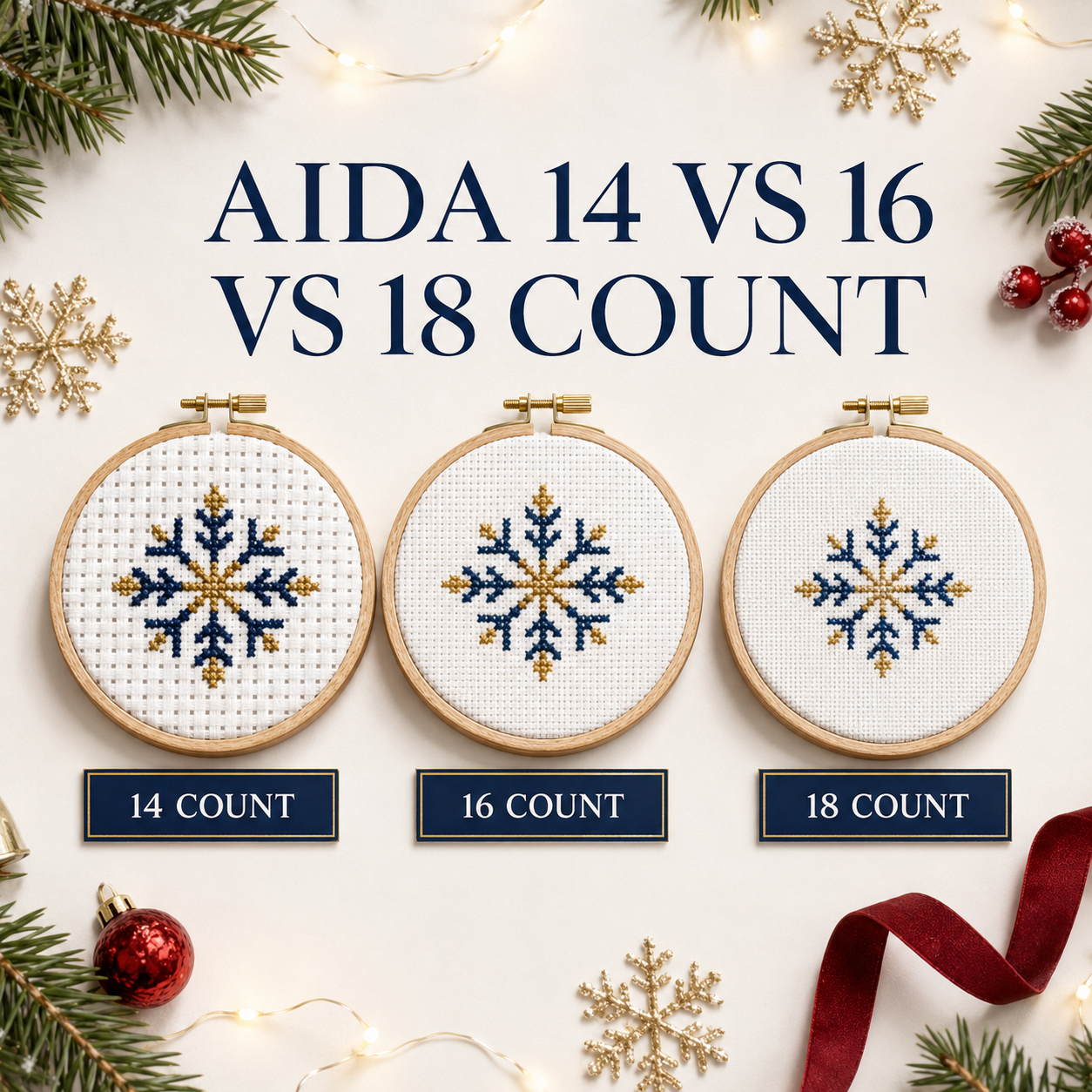
A higher fabric count creates smaller stitches.
A lower fabric count creates larger stitches.
This means that the same pattern becomes:
- larger on 11-count Aida;
- medium-sized on 14-count Aida;
- smaller on 16-count Aida;
- even smaller and finer on 18-count Aida.
The number of stitches in the pattern does not change. Only the physical size of each stitch and the finished embroidery changes.
Aida 11 vs 14 vs 16 vs 18 for Christmas Stockings
| Fabric count | Stitch size | Finished result | Difficulty | Common needle size |
|---|---|---|---|---|
| 11-count Aida | Largest | Large stocking with bold stitches | Easiest to see | Size 22 |
| 14-count Aida | Medium | Balanced size and detail | Beginner-friendly | Size 24 |
| 16-count Aida | Smaller | More compact and detailed | Intermediate | Size 26 |
| 18-count Aida | Finest | Small, detailed stocking | More challenging | Size 28 |
Needle sizes are practical starting points. Always follow the instructions provided with your pattern or kit.
The number of floss strands can also vary depending on the desired coverage, thread type, and pattern instructions. Do not automatically use the same number of strands on every fabric count.
Why 14-Count Aida Is the Best Choice for Most Stockings
A Christmas stocking is much larger than a typical cross stitch ornament. It may contain thousands of stitches, several colors, a personalized name, and backstitch details.
The fabric needs to be comfortable enough for a long project while still producing an attractive finished result.
The Holes Are Easy to See
The holes in 14-count Aida are clearly defined without making the stitches look excessively large.
This helps beginners:
- place stitches accurately;
- maintain consistent stitch direction;
- find their position after a break;
- avoid splitting fabric threads;
- work comfortably for longer sessions.
It Produces Good Detail
Fourteen-count Aida is fine enough to show:
- facial expressions;
- animal features;
- snowflakes;
- Christmas lights;
- lettering;
- small decorations;
- backstitch outlines.
At the same time, it does not make the design unnecessarily tiny.
It Creates a Practical Stocking Size
A design that measures approximately 249 stitches high will be about 17.8 inches or 45.2 cm high on 14-count Aida before considering any additional fabric beyond the stitched area.
That is close to the size many people expect from a full-size Christmas stocking.
It Is Suitable for Beginners and Experienced Stitchers
Beginners can see the holes clearly and follow the grid comfortably.
Experienced stitchers can still achieve detailed, professional results and add optional features such as metallic thread, beads, or a fabric lining.
How Fabric Count Changes the Finished Stocking Size
Use this formula to calculate the stitched design size:
Number of stitches ÷ fabric count = size in inches
To convert inches to centimeters:
Inches × 2.54 = centimeters
Imagine that a Christmas stocking pattern measures 132 stitches wide and 249 stitches high.
The approximate maximum stitched design area would be:
| Fabric | Width | Height |
|---|---|---|
| 11-count Aida | 12 in / 30.5 cm | 22.6 in / 57.5 cm |
| 14-count Aida | 9.4 in / 24 cm | 17.8 in / 45.2 cm |
| 16-count Aida | 8.25 in / 21 cm | 15.6 in / 39.5 cm |
| 18-count Aida | 7.3 in / 18.6 cm | 13.8 in / 35.1 cm |
These measurements describe the stitched design area. You still need additional fabric for margins, seam allowance, positioning, and finishing.
Use the free Cross Stitch Fabric Calculator before buying or cutting fabric. Enter the stitch width, stitch height, fabric count, and required margins to calculate the fabric size.
Is 11-Count Aida Good for a Christmas Stocking?
Eleven-count Aida has larger holes and creates larger stitches than 14-count Aida.
It can be a good choice for:
- children learning cross stitch;
- stitchers with reduced vision;
- people who have difficulty seeing smaller fabric holes;
- very simple designs;
- projects where a large finished stocking is intentional.
However, 11-count Aida also creates a much larger finished design.
A stocking chart designed for 14-count Aida may become too large when stitched on 11-count fabric. It may also require more floss because every stitch covers a larger physical area.
The stitches can look bolder and less refined, especially in designs with small facial features or detailed decorations.
Before changing from 14 count to 11 count:
- Calculate the new finished dimensions.
- Confirm that you have enough fabric.
- Check whether the larger stocking will fit your intended display.
- Recalculate the floss requirements.
- Choose a suitable needle and number of strands.
For a detailed comparison, read 11 Count vs 14 Count Aida for Stamped Cross Stitch.
Should You Use 16-Count Aida?
Sixteen-count Aida creates smaller stitches and a smaller finished stocking than 14-count Aida.
It is a good option if:
- you prefer a more compact stocking;
- you can comfortably see smaller holes;
- you already have counted cross stitch experience;
- you want slightly finer details;
- you are prepared to adjust the fabric, needle, and floss coverage.
A pattern that is 249 stitches high will measure approximately 15.6 inches or 39.5 cm high on 16-count Aida.
This may work for a decorative stocking, but it will be noticeably smaller than the same design stitched on 14 count.
Before choosing 16 count, consider how the stocking will be used. A smaller stocking may look elegant as decoration but may hold fewer gifts.
Is 18-Count Aida Suitable for a Christmas Stocking?
Eighteen-count Aida creates fine, compact stitches.
It can produce beautiful details, but it is not the easiest choice for a first Christmas stocking.
Choose 18 count only if:
- you are comfortable working with small holes;
- you have suitable lighting or magnification;
- you want a smaller decorative stocking;
- you understand how to adjust floss coverage;
- the pattern remains readable at the reduced size.
A 249-stitch-high design will be approximately 13.8 inches or 35.1 cm high on 18-count Aida.
This is much smaller than the same chart on 14-count fabric.
Eighteen-count Aida can also be more tiring for the eyes during a long project. A full-size Christmas stocking may contain thousands of stitches, so comfort matters as much as detail.
Can You Use Evenweave for a Cross Stitch Stocking?
Yes. Evenweave can create a smooth, elegant result, but it is usually better for experienced stitchers.
Evenweave is commonly stitched over two fabric threads.
For example:
- 28-count evenweave stitched over two is similar in stitch size to 14-count Aida.
- 32-count evenweave stitched over two is similar to 16-count Aida.
- 36-count evenweave stitched over two is similar to 18-count Aida.
Evenweave may be helpful for:
- fractional stitches;
- delicate lettering;
- detailed designs;
- stitchers who prefer a softer, more traditional fabric appearance.
However, it requires more careful counting. The holes are not grouped into obvious squares like Aida, making it easier for beginners to place a stitch in the wrong position.
If this is your first large stocking, Aida is usually the safer and more comfortable choice.
Read Aida vs Evenweave before changing the fabric recommended in your pattern.
Can You Use Linen?
Linen can create a beautiful heirloom appearance, but it is not the most practical choice for most beginner Christmas stockings.
Unlike Aida, natural linen may have small variations in the thickness and spacing of its threads. This gives the fabric character but makes counting more challenging.
Linen works best for:
- experienced counted cross stitchers;
- traditional or vintage-style designs;
- fine personalization;
- decorative stockings that will be handled carefully.
It is less suitable if:
- this is your first counted cross stitch project;
- you need clearly visible squares;
- the pattern is stamped directly on the fabric;
- you want the simplest finishing process.
For more information, read our guide to different cross stitch fabric types.
Stamped or Counted Fabric: Which Should You Choose?
The fabric choice also depends on how you want to stitch.
Stamped Aida
Stamped cross stitch fabric has the design printed directly on the Aida.
You follow the printed symbols while stitching. After every stitch, backstitch detail, and personalized letter is complete, the printed design is washed away according to the kit instructions.
Stamped Aida is helpful for:
- complete beginners;
- large Christmas stocking projects;
- stitchers who do not enjoy counting;
- people who frequently lose their place on a paper chart;
- anyone who wants a more relaxing stitching process.
Do not wash or wet stamped fabric before the entire embroidery is finished. The printed guide is water-soluble and cannot be restored after it disappears.
Blank Aida for Counted Cross Stitch
Counted cross stitch uses blank fabric and a separate paper or digital chart.
You count the squares and place each stitch in its correct position.
Blank Aida is a good choice for:
- experienced stitchers;
- people who enjoy following charts;
- digital PDF patterns;
- stitchers who want to choose their own fabric color and count.
Read Stamped vs Counted Cross Stitch Christmas Stocking Kits if you are unsure which method is right for you.
Can You Change the Fabric Count Listed in a Pattern?
You can usually stitch a counted cross stitch pattern on a different fabric count, but you must calculate the consequences first.
Changing fabric count affects:
- the finished size;
- the amount of fabric required;
- thread consumption;
- needle size;
- floss coverage;
- the space available for the name;
- the size of the backing and lining;
- the amount of fabric available for seam allowance.
The chart itself does not change. A symbol still represents the same stitch and DMC color.
However, a pattern designed to produce an 18-inch stocking on 14-count Aida will not remain 18 inches high on 16 or 18 count.
Never change fabric count without calculating the finished dimensions first.
If you are using stamped fabric, do not replace it with a different count. The printed design and grid have already been prepared specifically for that fabric.
What Color Aida Is Best?
White Aida is the most practical choice for most Christmas stocking designs.
It offers:
- strong contrast with chart markings;
- clearly visible holes;
- accurate thread colors;
- easier stitching in normal light;
- less eye strain than very dark fabric;
- compatibility with a wide range of Christmas colors.
Colored Aida can create a special effect, but the unstitched fabric may remain visible around the design.
Before choosing colored fabric, consider:
- whether the pattern assumes a white background;
- whether light floss will cover the fabric well;
- whether the fabric color changes the appearance of the thread;
- whether the design includes large unstitched areas;
- whether you can see the holes comfortably.
Dark blue or black Aida can create a dramatic winter background, but it is more difficult to stitch. Good lighting, a light-colored cloth behind the fabric, or magnification may be helpful.
How to Recognize Good-Quality Aida
A Christmas stocking requires many hours of work. Do not risk that work on badly woven or distorted fabric.
Good Aida should have:
- an even square grid;
- consistent hole spacing;
- straight horizontal and vertical lines;
- no stains or damaged sections;
- enough firmness to hold its shape;
- no severe warping;
- enough fabric around the design for finishing.
Before stitching, place the fabric on a flat surface and inspect the grid. The squares should not lean noticeably to one side.
If purchasing fabric separately, buy a slightly larger piece than the minimum calculation. Extra fabric can be trimmed later, but missing fabric cannot be replaced.
How Much Extra Fabric Do You Need?
Do not cut the fabric to the exact size of the stitched design.
You need additional space for:
- safe stitching margins;
- a hoop or frame;
- seam allowance;
- alignment;
- washing and pressing;
- the final stocking outline.
For many cross stitch projects, a general stitching margin of at least 2–3 inches on every side is comfortable. A Christmas stocking may require a different amount because of its curved shape and sewing template.
Follow the finishing instructions included with the pattern.
The sewing seam allowance is not always the same as the outer stitching margin. If the pattern includes a stocking template or cutting line, check whether the seam allowance is already included before adding more.
Never cut the stocking shape before:
- all stitching is complete;
- the personalized name is finished;
- stamped markings have been removed;
- the fabric is dry;
- the embroidery has been pressed safely;
- the cutting line has been checked twice.
What Fabric Should You Use for the Back of the Stocking?
Aida is normally used for the embroidered front. The stocking back does not need to be made from Aida.
A medium-weight woven cotton is one of the most practical backing choices.
It is:
- easy to cut and sew;
- available in many Christmas prints;
- stable and non-stretchy;
- strong enough for a decorative stocking;
- comfortable for beginners to handle.
Other possible backing fabrics include:
- cotton twill;
- lightweight canvas;
- velvet;
- corduroy;
- felt;
- quilting cotton supported with interfacing.
Avoid very stretchy or slippery fabrics unless you have sewing experience. They may shift while sewing and distort the stocking shape.
If the backing fabric is thin, lightweight interfacing can help it hold its shape.
CrossStitchStyleArte physical kits include backing fabric prepared for completing the stocking.
What Is the Best Fabric for the Lining?
Lightweight cotton is the easiest and most practical lining fabric.
A lining:
- hides the back of the embroidery;
- covers thread ends;
- creates a clean interior;
- prevents gifts from catching on stitches;
- gives the stocking a professional finish.
Choose a smooth, tightly woven fabric that is not too bulky.
Avoid heavy lining fabric because it can make the toe and heel difficult to turn.
The lining is optional. An unlined stocking can still be attractive and functional, especially if it will mainly be used as a decoration.
For complete assembly instructions, follow our guide explaining how to finish and sew a cross stitch Christmas stocking.
Do You Need Interfacing or Batting?
Interfacing and batting are optional.
Use Lightweight Interfacing If:
- the backing fabric is thin;
- you want the stocking to hold its shape;
- you prefer a crisp finished appearance.
Aida is already fairly firm, so interfacing may only be necessary behind the backing fabric.
Do not automatically iron fusible interfacing directly onto completed embroidery. Heat and adhesive may affect the stitches. Test it first or use a sew-in stabilizer.
Use Thin Batting If:
- you want a soft, padded stocking;
- the finished stocking will be decorative;
- you are adding a full lining.
Avoid thick batting. It can make the seams bulky and hide the shape of the toe and heel.
Best Fabric Choice by Stitcher
| Your situation | Recommended fabric |
|---|---|
| Complete beginner | 14-count Aida |
| Stamped cross stitch beginner | Pre-printed 14-count Aida |
| Traditional counted cross stitch | Blank 14-count Aida |
| Reduced vision or difficulty seeing holes | 11-count Aida |
| Smaller decorative stocking | 16-count Aida |
| Experienced stitcher wanting fine detail | 18-count Aida or evenweave |
| Elegant traditional finish | Evenweave or linen |
| Easy backing fabric | Medium-weight cotton |
| Easy lining fabric | Lightweight cotton |
Common Fabric Mistakes to Avoid
Choosing Fabric Only by Appearance
A beautiful color is not enough. Check the fabric count, weave, size, and compatibility with the pattern.
Assuming Higher Count Means a Larger Design
The opposite is true.
A higher fabric count creates smaller stitches and a smaller finished design.
Forgetting to Recalculate the Finished Size
Never switch from 14 count to 11, 16, or 18 count without calculating the new dimensions.
Buying Only the Exact Stitched Size
You need additional fabric for handling, positioning, and sewing.
Cutting Before Washing Stamped Fabric
Complete all stitching and personalization first. Wash, dry, and press the fabric before cutting.
Using Stretch Fabric for the Embroidered Front
Cross stitch requires an even, stable grid. Stretch fabric can distort stitches and change the stocking shape.
Forgetting the Backing and Lining
The embroidered Aida is only the front of the stocking. Plan the complete project before beginning.
Frequently Asked Questions
What fabric count is best for a Christmas stocking?
Fourteen-count Aida is the best choice for most Christmas stockings. It creates a practical size, provides good detail, and is comfortable for beginners and experienced stitchers.
Is 11-count or 14-count Aida better for beginners?
Eleven count has larger holes and may be easier to see, but it creates a much larger design. Fourteen count offers a better balance between visibility, detail, and finished stocking size.
Does higher Aida count make the stocking larger or smaller?
Higher Aida count makes the stocking smaller. More stitches fit into every inch of fabric.
Can I use 16-count Aida instead of 14 count?
Yes, for a counted cross stitch pattern, but the finished stocking will be smaller. Recalculate the dimensions, fabric size, thread coverage, and finishing pieces before starting.
Can I use a different fabric for a stamped pattern?
No. The design is printed directly on the original stamped fabric and aligned with its grid. Use the fabric supplied with the kit.
What is the best backing fabric?
Medium-weight woven cotton is the easiest and most practical backing fabric. It is stable, durable, and beginner-friendly.
Does a cross stitch stocking need a lining?
No. A lining is optional, but it hides the back of the stitches and creates a cleaner interior.
Should I wash Aida before stitching?
Do not wash stamped Aida before stitching because the printed guide is water-soluble. For blank counted Aida, follow the fabric and pattern instructions. Washing may remove some of the factory stiffness.
How much fabric should I buy?
Calculate the stitched dimensions and add enough fabric for handling, positioning, seam allowance, and finishing. Use the Fabric Calculator and follow the cutting template included with the pattern.
Choose Your Christmas Stocking Fabric with Confidence
For most stitchers, high-quality 14-count Aida is the safest and most practical choice for a cross stitch Christmas stocking.
It is comfortable to stitch, detailed enough for beautiful Christmas designs, and produces a full-size stocking that looks balanced when displayed.
Choose pre-printed Aida if you want an easier guided experience. Choose blank Aida if you enjoy counted cross stitch and following a chart.
Before changing fabric count, always calculate the new finished dimensions. A few minutes of planning can prevent you from purchasing the wrong fabric or creating a stocking that is much larger or smaller than expected.
Explore our personalized Christmas stocking cross stitch patterns and kits to find a design for your next family Christmas project.
For help with the entire process, read How to Cross Stitch a Christmas Stocking: Complete Beginner Guide.