Cross Stitch Fabric Types: Aida, Evenweave, Linen and More
Choosing the right cross stitch fabric is easier when you understand three things: how the fabric is woven, what its count means, and how large you want the finished design to be.
Aida is usually the simplest choice for a beginner. Evenweave and linen create a smoother background and make fractional stitches easier. Waste canvas and water-soluble canvas let you add cross stitch to clothing and other ordinary fabrics. Perforated paper and plastic canvas work well for small, shaped projects.
This guide explains the most useful cross stitch fabric types, how fabric count changes the finished size, and how to select fabric that fits your pattern and skill level.
Quick Comparison of Cross Stitch Fabric Types
| Fabric type | Best for | Main advantage | Important limitation |
|---|---|---|---|
| Aida | Beginners, counted patterns, Christmas stockings | Clear, easy-to-see squares | Fractional stitches can be less convenient |
| Evenweave | Detailed patterns, fractional stitches, refined finishes | Smooth, regular weave | You count fabric threads instead of visible blocks |
| Linen | Samplers, heirloom projects, traditional designs | Natural texture and elegant appearance | Individual threads may vary in thickness |
| Waste canvas | Clothing, tote bags, cushions | Makes a temporary grid on ordinary fabric | Every canvas thread must be removed after stitching |
| Water-soluble canvas | Clothing and irregular areas | The temporary grid dissolves in water | The finished item must tolerate washing or soaking |
| Perforated paper | Cards, bookmarks, ornaments | Stiff and easy to hold without a hoop | Can bend or tear and is not washable |
| Plastic canvas | Magnets, decorations, three-dimensional crafts | Strong and easy to cut into shapes | Produces a rigid rather than fabric-like result |
What Is Cross Stitch Fabric?
Counted cross stitch needs a regular grid. The grid tells you where each X-shaped stitch belongs.
On Aida, that grid is formed by clearly visible blocks. On evenweave and linen, you create the grid by counting individual fabric threads. Temporary canvases place a removable grid over fabric that does not already have one.
The fabric affects:
- the finished size of the design;
- how large each stitch appears;
- how easily you can see and count the stitching holes;
- the amount of background fabric visible between the stitches;
- how many strands of embroidery floss may give suitable coverage;
- how easy it is to make fractional stitches and detailed backstitching;
- the texture and drape of the completed work.
Always check the pattern instructions before buying fabric. A well-prepared PDF pattern should state the design size in stitches, the recommended fabric count, and the estimated finished dimensions. If you are still choosing a chart, use this quality cross stitch pattern checklist before purchasing.
Aida Fabric: The Best Starting Point for Most Beginners
Aida is woven into distinct square blocks with a hole at each corner. One complete cross stitch normally covers one Aida square.
Because the squares are easy to see, Aida reduces the amount of counting required. It is a practical choice for:
- first cross stitch projects;
- large counted patterns;
- Christmas stockings;
- full-cross-stitch designs;
- stitchers who find small holes difficult to see;
- projects that need a firm, stable fabric.
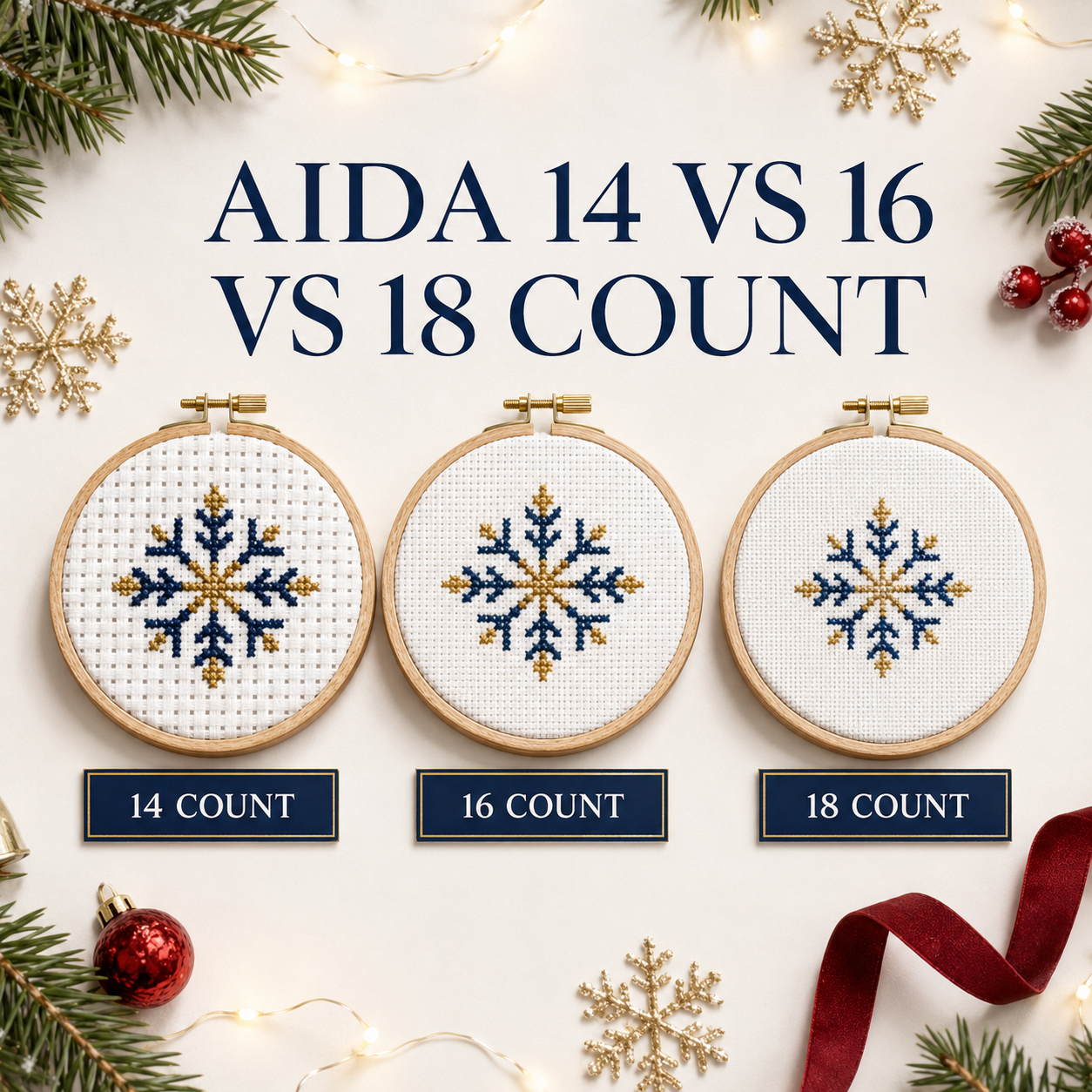
Common Aida counts include 11, 14, 16, 18 and 20. The number tells you how many stitch squares fit into one inch of fabric.
For example, 14-count Aida has 14 squares per inch. A design that is 140 stitches wide will measure 10 inches wide on 14-count Aida before adding any margins:
140 stitches ÷ 14 stitches per inch = 10 inches
Which Aida Count Is Best?
- 11-count Aida: Large holes and large stitches. Helpful for children, limited vision and very simple patterns, but the result can look more pixelated.
- 14-count Aida: The most practical all-purpose option. It is easy to see, widely available and suitable for many beginner and intermediate patterns.
- 16-count Aida: Produces a slightly smaller and finer result while remaining manageable for many stitchers.
- 18-count Aida: Creates smaller stitches and a more detailed appearance, but requires better lighting and more careful counting.
- 20-count Aida and higher: Best for experienced stitchers who are comfortable working with very small stitches.
If you want a detailed comparison between block-weave and thread-count fabrics, read Aida vs Evenweave: What’s the Difference?.
Evenweave Fabric: A Smooth and Flexible Option
Evenweave fabric has the same number of threads per inch horizontally and vertically. Unlike Aida, it does not have obvious square blocks. You count fabric threads to place each stitch.
Cross stitch on evenweave is commonly worked over two fabric threads. This means the needle passes across two threads horizontally and two threads vertically to form one full cross stitch.
Evenweave is useful when a pattern contains:
- quarter stitches or three-quarter stitches;
- detailed backstitching;
- small lettering;
- delicate faces or curved outlines;
- areas stitched over one thread;
- a large amount of unstitched background.
The smoother background can give the finished project a more refined appearance. Evenweave is not reserved for experts, but it does require more attention than Aida because the stitcher must count fabric threads rather than visible squares.
Popular evenweave fabrics include cotton and cotton-blend options such as Lugana and Jobelan. Their feel and stiffness vary, so check the fiber content and manufacturer’s description before buying.
Linen Fabric: Natural Texture for Traditional Projects
Cross stitch linen is an even-count woven fabric made from flax fibers. It is often used for traditional samplers, heirloom projects and designs where the background remains visible.
Like evenweave, linen is commonly stitched over two fabric threads. Its natural fibers may contain slight changes in thickness, sometimes called slubs. These variations are part of linen’s appearance, but they can make the holes look less uniform than those in Aida or cotton evenweave.
Choose linen when you want:
- a natural, traditional background;
- a softer drape;
- a project intended for framing or long-term display;
- the option to combine over-one and over-two stitching;
- an elegant finish with visible fabric texture.
Linen is not automatically better than Aida or evenweave. The best fabric is the one that suits the design and allows you to stitch accurately and comfortably.
Aida, Evenweave and Linen Count Conversion
Aida count measures stitch squares per inch. Evenweave and linen count measure individual fabric threads per inch.
When evenweave or linen is stitched over two threads, divide the fabric count by two to find the effective stitch count.
| Aida | Evenweave or linen stitched over 2 | Approximate stitches per inch |
| 11-count Aida | 22-count over 2 | 11 |
| 14-count Aida | 28-count over 2 | 14 |
| 16-count Aida | 32-count over 2 | 16 |
| 18-count Aida | 36-count over 2 | 18 |
| 20-count Aida | 40-count over 2 | 20 |
For example, a design stitched on 14-count Aida and the same design stitched over two threads on 28-count evenweave will have approximately the same stitched dimensions.
This equivalence applies only when the evenweave or linen is stitched over two threads. If you stitch over one thread on 28-count fabric, the design will have 28 stitches per inch and will be half the width and half the height of the same design on 14-count Aida.
Waste Canvas: Cross Stitch on Clothing and Home Textiles
Waste canvas is a temporary grid that you place over non-counted fabric. It allows you to cross stitch on denim jackets, tote bags, cushions, aprons and other woven items.
How to Use Waste Canvas
- Wash and dry the item first if it may shrink.
- Position the canvas carefully and check that its grid is straight.
- Secure it with basting stitches rather than relying only on pins.
- Stitch through both the waste canvas and the fabric beneath it.
- Follow the manufacturer’s instructions; many types are easier to remove after being dampened.
- Pull out one canvas thread at a time without pulling the embroidery.
Waste canvas works best on stable woven fabric. Very stretchy or loosely woven material can distort the stitches unless it is supported with a suitable stabilizer.
Water-Soluble Canvas: A Grid That Dissolves
Water-soluble canvas is another way to add counted cross stitch to ordinary fabric. Instead of pulling out the grid thread by thread, you dissolve it in water after stitching.
It is useful for:
- small motifs on clothing;
- curved or awkwardly shaped areas;
- fabrics where removing waste-canvas threads would be difficult;
- projects requiring a clean temporary grid.
Before using it, confirm that the garment, embroidery floss and any stabilizer can be safely soaked or thoroughly rinsed. Test dark or hand-dyed floss for colorfastness because running dye can stain the surrounding fabric.
Perforated Paper and Plastic Canvas
Perforated Paper
Perforated paper has evenly spaced holes and is commonly used for:
- greeting cards;
- gift tags;
- bookmarks;
- flat Christmas ornaments;
- small decorative projects.
It does not need a hoop, but it can tear if the thread is pulled too tightly. Avoid carrying dark floss across large empty areas on the back because it may show through the holes.
Plastic Canvas
Plastic canvas is rigid, washable and easy to cut. It works well for:
- magnets;
- coasters;
- ornaments;
- decorations with shaped edges;
- boxes and three-dimensional crafts.
Use a needle and yarn or floss that fit comfortably through the holes. Do not force an overloaded needle because it can damage the canvas or fray the thread.
What Does Fabric Count Mean?
Fabric count tells you how many stitch positions fit into one inch.
The rule is simple:
- lower count = larger stitches and a larger finished design;
- higher count = smaller stitches and a smaller finished design.
The number of stitches in the pattern does not change. Only the physical size of each stitch changes.
Example: One Pattern on Different Aida Counts
Suppose a pattern is 140 stitches wide and 210 stitches high.
| Fabric | Stitched width | Stitched height |
| 11-count Aida | 12.73 in / 32.33 cm | 19.09 in / 48.49 cm |
| 14-count Aida | 10 in / 25.4 cm | 15 in / 38.1 cm |
| 16-count Aida | 8.75 in / 22.23 cm | 13.13 in / 33.34 cm |
| 18-count Aida | 7.78 in / 19.76 cm | 11.67 in / 29.63 cm |
Do not choose a different count only to make a design fit a small piece of fabric. First check whether you can comfortably see the holes, whether the floss provides suitable coverage, and whether the new finished dimensions work for the intended frame or finished object.
How to Calculate the Fabric Size You Need
First calculate the stitched area:
Design width in stitches ÷ effective fabric count = stitched width in inches
Design height in stitches ÷ effective fabric count = stitched height in inches
Then add finishing margins to every side.
For a framed project, a common starting allowance is 2–3 inches (approximately 5–7.5 cm) on each side. Some finishing methods require more. Christmas stockings, cushions and sewn objects need the seam, backing and construction allowances specified in their instructions.
The safest method is to use the free Cross Stitch Fabric Calculator. Enter the design width and height in stitches, select the effective fabric count and add the margin required for your finishing method.
Never cut the fabric to the exact stitched dimensions. A design without margins is difficult or impossible to frame, sew or finish properly.
How Many Floss Strands Should You Use?
There is no single correct number for every fabric and every stitcher. Coverage changes with the fabric count, thread color, stitch tension and desired appearance.
The following ranges are practical starting points for full cross stitch with standard six-strand cotton floss:
| Fabric | Suggested starting point |
| 11-count Aida | 3 strands |
| 14-count Aida | 2 strands |
| 16-count Aida | 2 strands |
| 18-count Aida | 1–2 strands |
| 28-count evenweave over 2 | 2 strands |
| 32-count evenweave over 2 | 2 strands |
| 36-count linen over 2 | 1–2 strands |
These are starting points, not fixed rules. Make a small test section before beginning the main project. Check it in the same lighting in which the finished piece will be displayed.
Dark floss often appears to cover the fabric more fully than very light floss. Dark fabric can also show through light stitches more noticeably. If you need to estimate total floss before starting, use the Cross Stitch Thread Calculator.
How to Choose the Best Fabric Color
Fabric color is part of the finished design, especially when large areas remain unstitched.
Before choosing a color:
- Look at the pattern mockup and identify the lightest and darkest thread colors.
- Check that important outlines will remain visible against the fabric.
- Place real floss samples on the fabric instead of relying only on a screen.
- Examine the combination in daylight and artificial light.
- Test hand-dyed or dark fabric for colorfastness if the project may be washed.
White and antique white are flexible choices for many patterns. Cream can soften traditional or warm palettes. Dark fabric creates strong contrast but requires good lighting and careful counting. If you choose a dark background, use the practical advice in How to Cross Stitch on Black Fabric.
Which Cross Stitch Fabric Is Best for Beginners?
For most beginners, 14-count Aida in a light or medium color is the safest choice.
It provides:
- holes that are easy to see;
- a predictable finished size;
- good compatibility with two strands of cotton floss;
- enough structure to handle comfortably;
- wide availability in craft stores.
Choose 11-count Aida if 14-count holes are too small. Choose 16-count Aida if you can see it comfortably and want a slightly smaller, finer result.
Do not begin with black fabric, very high counts or irregular linen simply because they look more professional. Difficulty does not equal quality. Accurate stitches on comfortable fabric will produce a better result than a fashionable fabric you cannot see or count reliably.
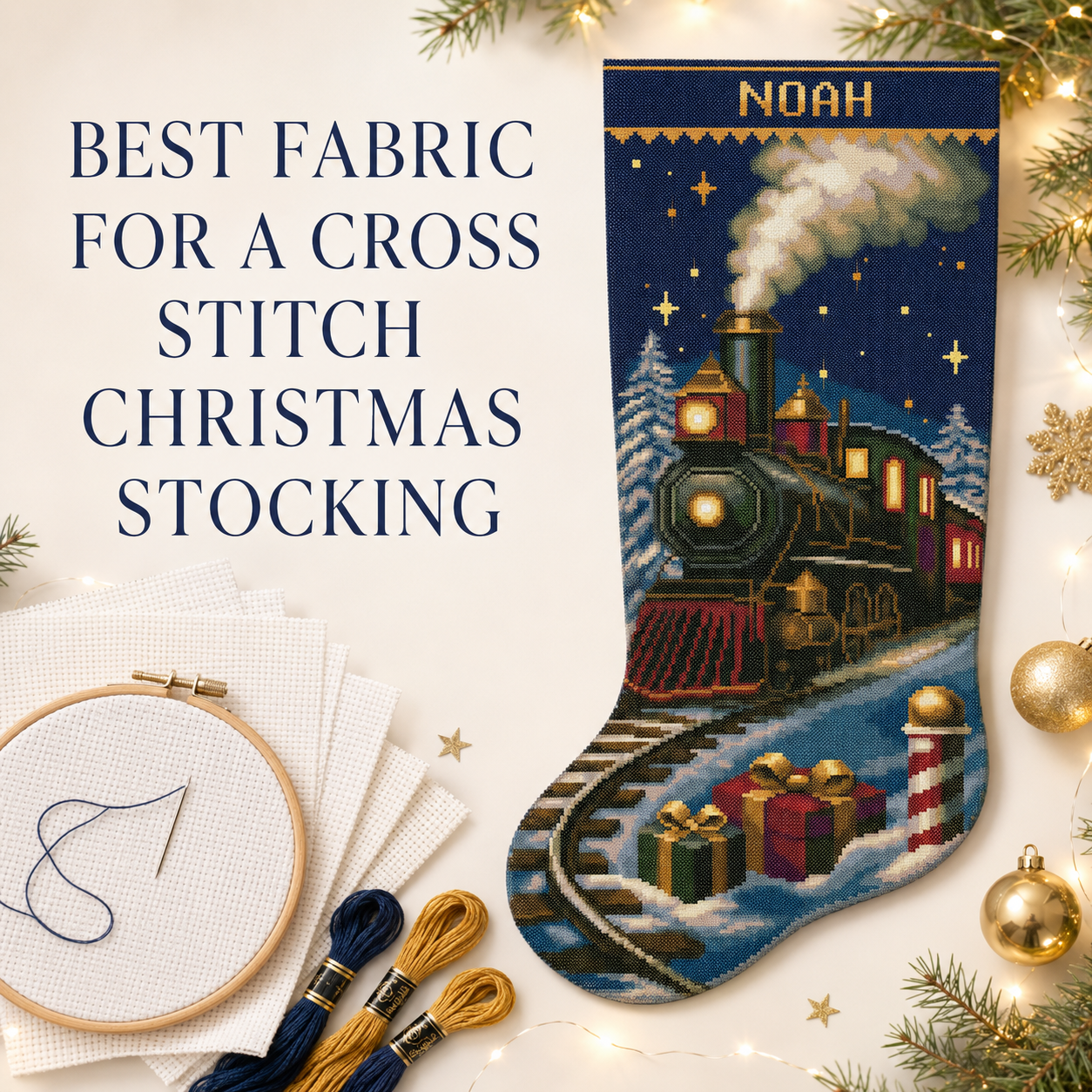
Which Fabric Is Best for a Cross Stitch Christmas Stocking?
For counted Christmas stocking patterns, 14-count Aida is a practical choice because it is beginner-friendly and produces clearly defined stitches. CrossStitchStyleArte digital stocking patterns list the design size in stitches and the expected dimensions on 14-count Aida.
Before cutting fabric for a stocking, remember that the stitched area is not the same as the final cut shape. You must also follow the pattern’s instructions for:
- the stocking outline;
- seam allowance;
- cuff and name area;
- backing fabric;
- lining, if used;
- hanging loop;
- finishing and assembly.
If you do not want to source every material separately, a complete 2-in-1 kit can be more convenient. CrossStitchStyleArte Christmas stocking kits include both a stamped stitching option and white 14-count Aida for counted cross stitch, allowing the stitcher to choose the preferred method. Read the stamped vs counted cross stitch kit guide before deciding.
Common Cross Stitch Fabric Mistakes
Confusing Fabric Count with Fabric Size
Count describes the density of the grid. It does not tell you the width or height of the fabric piece.
Forgetting the Finishing Margin
Always add fabric around the stitched design. The necessary amount depends on whether the project will be framed, sewn or turned into another object.
Treating 28-Count Evenweave as 28 Stitches per Inch
It equals 14 stitches per inch only when stitched over two threads. Over one thread, it provides 28 stitches per inch.
Changing the Recommended Count Without Recalculating
A different fabric count changes the physical dimensions of the design. Recalculate before buying or cutting fabric.
Choosing Fabric by Appearance Alone
Make sure you can see the holes and count comfortably. Consider lighting, contrast, stitch detail and finishing requirements.
Skipping a Floss Coverage Test
Test a small group of stitches first. It is easier to change the number of strands before stitching hundreds of crosses.
Pulling the Fabric Too Tight in a Hoop
The fabric should be comfortably taut, not stretched out of shape. Excess tension can distort the weave and change the appearance of the stitches.
A Simple Fabric Decision Checklist
Before ordering fabric, confirm all of the following:
- I know the design width and height in stitches.
- I checked the count recommended by the pattern designer.
- I understand whether the design is stitched over one or two fabric threads.
- I calculated the stitched dimensions on my chosen count.
- I added enough margin for the final finishing method.
- I can comfortably see and count the fabric holes.
- The fabric color provides enough contrast with the floss.
- I tested the planned number of floss strands.
- The fabric and thread can be cleaned using compatible methods.
When all nine answers are yes, the fabric is likely suitable for the project.
Plan Your Next Cross Stitch Project
Start with the pattern, not with a random fabric cut. Check the stitch dimensions, choose a count you can work on comfortably, calculate the required fabric size and test your floss coverage.
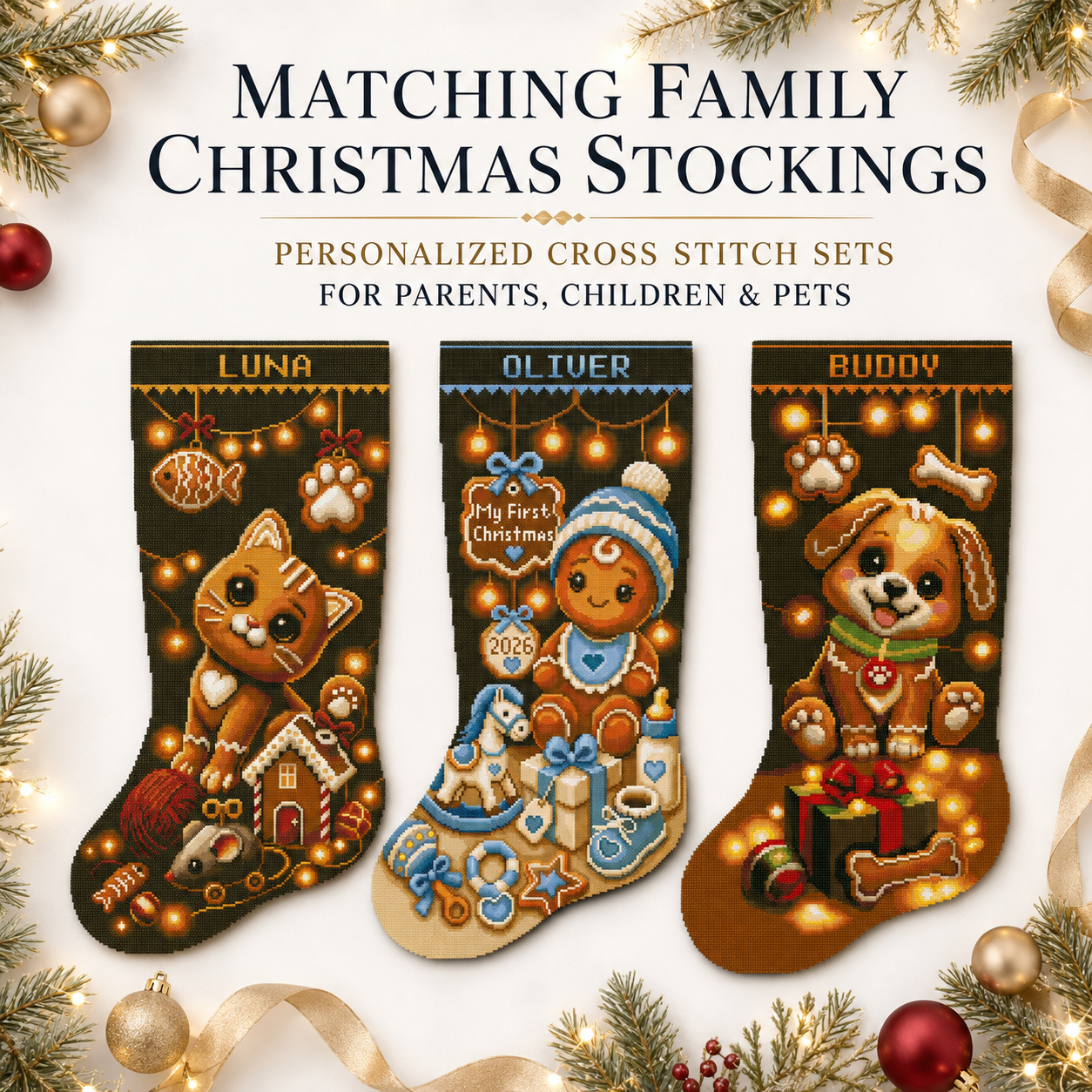
Use the free Cross Stitch Fabric Calculator to calculate an accurate cut before buying fabric. Then explore the CrossStitchStyleArte cross stitch patterns for clearly presented digital designs, including personalized Christmas stocking patterns created for 14-count Aida.
Frequently Asked Questions About Cross Stitch Fabric
What is the easiest cross stitch fabric for beginners?
Light-colored 14-count Aida is the easiest option for most beginners. Its square blocks and stitching holes are easy to see, and two strands of cotton floss usually provide a practical starting level of coverage.
Is Aida the same as evenweave?
No. Aida forms visible square blocks. Evenweave has evenly spaced individual threads and is normally stitched by counting over one or two threads.
Is 28-count evenweave the same size as 14-count Aida?
Yes, when the 28-count evenweave is stitched over two fabric threads. Both provide approximately 14 full stitches per inch.
Does higher fabric count make a design bigger or smaller?
Higher count makes each stitch smaller, so the same pattern produces a smaller finished design. Lower count produces larger stitches and a larger design.
Can I use a different fabric count than the pattern recommends?
Usually, yes, if the stitch structure is compatible. Recalculate the finished dimensions and fabric size first, and test whether your chosen number of floss strands provides suitable coverage.
How much extra fabric should I leave around a cross stitch design?
For framing, 2–3 inches (about 5–7.5 cm) on each side is a common starting point. Sewn items and Christmas stockings may need different allowances, so follow the project’s finishing instructions.
Can I cross stitch directly on clothing?
You can add cross stitch to stable woven clothing by using waste canvas or water-soluble canvas as a temporary grid. Stretch fabrics may also require stabilizer.
Should I wash cross stitch fabric before stitching?
Follow the fabric and pattern instructions. Prewashing can remove sizing and allow washable fabric to shrink before stitching, but hand-dyed fabrics may need special care. Always test for colorfastness first.