How Many Strands of Floss Should I Use for Cross Stitch? Complete Aida Count Guide
Wondering how many strands of floss for cross stitch you should use? For most projects, two strands are the best starting point. However, the correct number depends on your fabric count, the type of stitch, the thread, and how full you want the finished stitches to look.
A project stitched on 11-count Aida usually needs more strands than the same project stitched on 18-count Aida. Backstitch normally uses fewer strands than full cross stitches. A stamped cross-stitch kit may also give different instructions from a counted pattern.
This beginner-friendly guide explains everything step by step. You will learn what a strand is, how to separate embroidery floss, how many strands to use on different Aida counts, and how to test the coverage before beginning a large project.
If this is your first project, you may also want to read our complete cross-stitch guide for beginners.
Quick Answer: How Many Strands of Floss Should You Use?
Always follow the instructions included with your pattern or cross-stitch kit first.
If no instructions are provided, use this table as a practical starting point:
| Fabric | Full Cross Stitch | Backstitch | Coverage |
|---|---|---|---|
| 11-count Aida | 3 strands | 1–2 strands | Good, full coverage |
| 14-count Aida | 2 strands | 1 strand | Standard coverage |
| 16-count Aida | 2 strands | 1 strand | Full, neat coverage |
| 18-count Aida | 1–2 strands | 1 strand | Light to full coverage |
| 20- or 22-count Aida | 1 strand | 1 strand | Fine, delicate coverage |
These are starting recommendations, not strict rules. Your pattern instructions should always come first.
Thread color, stitching tension, fabric color, and personal preference can change how the stitches look. When unsure, make a small test before beginning the main design.
What Does “One Strand of Floss” Mean?
A standard skein of stranded embroidery floss is made from several thin threads twisted together.
For example, DMC Six-Strand Embroidery Floss contains six easily separated strands and is sold in skeins measuring 8 meters or 8.7 yards.
The words below do not mean the same thing:
- A skein is the complete bundle of embroidery floss you buy.
- A length is a piece you cut from the skein.
- A strand is one thin thread separated from that cut length.
When a pattern says “use two strands,” it does not mean that you should use two complete six-strand pieces. It means that you should separate two thin strands from the six-strand floss.
A Simple Example
Imagine that the complete piece of floss is like a small rope made from six thin strings.
If your pattern requires:
- one strand, remove and use one thin string;
- two strands, remove and use two thin strings together;
- three strands, remove and use three thin strings together.
Do not put all six strands into the needle unless the pattern specifically tells you to do so.
First Rule: Follow the Pattern Instructions
Before choosing the number of strands yourself, check the pattern key, color legend, or instruction page.
You may see instructions such as:
- full cross stitch with two strands;
- half stitch with two strands;
- backstitch with one strand;
- French knots with two strands;
- one strand of one color blended with one strand of another color.
A carefully prepared pattern chooses the number of strands to create the intended appearance.
One design can even use different numbers of strands in different areas. For example, the main subject may be stitched with two strands, while a soft background is stitched with one strand.
What About Stamped Cross-Stitch Kits?
A stamped cross-stitch kit has colors or symbols printed directly on the fabric. The printed marks tell you where to place the stitches, but they do not automatically tell you how many strands to use.
Check the kit instructions before threading your needle.
Many 11-count stamped kits use three strands for full crosses, but this is not a universal rule. Some kits use two strands, while others may use a different type or thickness of thread.
Never assume that stamped cross stitch requires all six strands.
How Aida Count Changes the Number of Strands
Aida count tells you how many fabric squares fit into one inch.
For example:
- 11-count Aida has 11 squares per inch;
- 14-count Aida has 14 squares per inch;
- 16-count Aida has 16 squares per inch;
- 18-count Aida has 18 squares per inch.
A lower number creates larger fabric squares and larger crosses. A higher number creates smaller fabric squares and smaller crosses.
Therefore:
- larger crosses usually need more strands for good coverage;
- smaller crosses usually need fewer strands;
- too few strands can make the fabric show through;
- too many strands can make the stitches crowded and difficult to place.
How Many Strands for 11-Count Aida?
For 11-count Aida, start with three strands for full cross stitches.
The fabric squares are relatively large, so two strands may create light coverage. Three strands normally make the crosses look fuller without becoming too bulky.
Use:
- two strands for light or airy coverage;
- three strands for standard full coverage;
- four strands only if you want very dense coverage and the needle passes comfortably through the fabric;
- one or two strands for backstitch.
Four strands can make the holes crowded, especially where several stitches share the same hole. Always test before using four strands throughout an entire project.
Best Starting Choice for 11-Count Aida
For a beginner using ordinary six-strand cotton floss:
Start with three strands for full crosses and one strand for fine backstitch.
If the outline looks too thin, try two strands for the backstitch.
How Many Strands for 14-Count Aida?
For 14-count Aida, two strands are the most common starting choice.
This combination produces balanced coverage for many counted and stamped cross-stitch projects. It is also easy to use with a loop start.
Use:
- one strand for very fine, delicate, or intentionally light stitching;
- two strands for standard coverage;
- three strands for fuller coverage;
- one strand for most backstitch.
Three strands can be useful when:
- you do not want the fabric to show between the crosses;
- the thread color strongly contrasts with the fabric;
- your stitching tension is tight;
- you prefer a thick, plush appearance.
However, three strands use more floss and can make shared holes crowded.
Two or Three Strands for 14-Count Aida?
Choose two strands if you want:
- a traditional cross-stitch appearance;
- easier stitching;
- clearly defined X-shaped crosses;
- lower thread consumption;
- a simple loop start.
Choose three strands if you want:
- fuller coverage;
- less visible fabric;
- thicker-looking stitches;
- stronger color.
Neither choice is automatically wrong. Make a small test and select the appearance you prefer.
How Many Strands for 16-Count Aida?
For 16-count Aida, start with two strands for full cross stitches.
Because the squares are smaller than those on 14-count Aida, two strands generally produce neat and relatively full coverage.
Use:
- one strand for light or delicate coverage;
- two strands for standard full crosses;
- three strands only after testing;
- one strand for most backstitch.
Three strands may feel crowded on 16-count fabric, especially in detailed areas containing fractional stitches or several colors.
For most beginners, two strands are easier to control.
How Many Strands for 18-Count Aida?
For 18-count Aida, use one or two strands for full cross stitches.
Choose one strand for:
- delicate stitching;
- a lighter, flatter appearance;
- projects where individual crosses should remain very clear;
- designs with many small details.
Choose two strands for:
- fuller coverage;
- stronger colors;
- less visible fabric;
- a thicker finished texture.
Two strands are still commonly used on 18-count Aida, but the holes are smaller. Use an appropriately fine tapestry needle and avoid pulling the stitches too tightly.
Three strands are usually too thick for ordinary 18-count Aida unless a special effect is required.
How Many Strands for 20- or 22-Count Aida?
For 20- or 22-count Aida, start with one strand.
These fabrics create small, fine stitches. Two strands may be possible, but they can make the holes crowded and reduce the definition of the crosses.
Fine-count fabrics can also be more difficult for a young child or a complete beginner to see. For a first project, 11- or 14-count Aida is usually easier to handle.
Why the Same Number of Strands Can Look Different
Two people can use the same fabric and the same number of strands but get slightly different results.
Several factors affect the final coverage.
Stitching Tension
Tension means how tightly you pull the thread.
If you pull very tightly:
- the floss becomes flatter and thinner;
- more fabric may show;
- the fabric can become distorted.
If the thread is too loose:
- the stitches may look uneven;
- the floss can snag;
- the crosses may not lie neatly.
The thread should rest gently on the fabric. It should not pull the fabric holes inward.
Fabric and Thread Color
High contrast makes gaps more noticeable.
For example, dark thread on white fabric can make every tiny piece of visible fabric stand out. Light thread on very dark fabric can create the same effect.
You may prefer an additional strand for high-contrast combinations, but test it first.
Thread Type
Not every embroidery thread has the same thickness.
Standard stranded cotton, satin floss, metallic thread, wool, and pearl cotton behave differently. Some threads are divisible, while others must be used as one complete thread.
Do not try to separate a non-divisible thread. Check the label or pattern instructions.
For example, DMC Diamant is a non-divisible metallic thread designed to be used as it comes from the reel. It is approximately equivalent in thickness to two strands of standard stranded cotton.
Stitching Method
The English method completes one X at a time. The Danish method works a row of lower diagonal stitches and then returns with the upper diagonals.
Both methods can produce beautiful results. However, differences in thread direction, tension, and how the strands lie may slightly change the appearance of the coverage.
Railroading
Railroading is a technique that helps two strands lie side by side instead of twisting around each other.
Before inserting the needle into the fabric, bring the needle between the two strands. This separates them and helps create flatter, smoother stitches.
Railroading can improve coverage without adding another strand.
The Five-Minute Coverage Test
The safest way to choose between one, two, or three strands is to make a small test.
Use the same fabric and thread that you plan to use for the project.
Step 1: Choose a Testing Area
Use a spare piece of the same fabric or an edge that will later be hidden by framing or finishing.
Step 2: Stitch a Small Block
Make three small blocks, each approximately 5 × 5 or 10 × 10 stitches:
- one block with one strand;
- one block with two strands;
- one block with three strands.
You do not need to test all three options if your pattern already recommends a starting number.
Step 3: Look at the Test Normally
Do not judge the stitches from only a few centimeters away.
Place the fabric on a table or hold it at a normal viewing distance. Ask:
- Can I clearly see the X-shaped stitches?
- Does too much fabric show through?
- Do the stitches look crowded?
- Is it difficult to pass the needle through shared holes?
- Which block looks best to me?
Step 4: Check the Back
Make sure that the thread does not create large, tight bundles on the back. Too much bulk can make finishing and framing more difficult.
Step 5: Record Your Choice
Write the chosen number of strands on your pattern or project card.
This is especially helpful if you put the project away and return to it several weeks later.
How Many Strands for Different Cross-Stitch Techniques?
Different types of stitches do not always use the same number of strands.
| Stitch Type | Common Starting Point | Important Note |
|---|---|---|
| Full cross stitch | 2 strands | Adjust for fabric count |
| Half cross stitch | Same as full cross | Follow the pattern |
| Backstitch | 1 strand | Use 2 for a bolder line |
| Quarter stitch | Same as full cross | Keep tension gentle |
| Three-quarter stitch | Same as full cross | Avoid crowding shared holes |
| French knot | 1–2 strands | Size also depends on wraps |
| Blended cross | Usually 2 total | Often one strand of each color |
Full Cross Stitches
A full cross stitch has two diagonal legs that form an X.
For ordinary 14- or 16-count Aida, two strands are a reliable starting point.
Keep all upper diagonal legs facing in the same direction. This often improves the appearance more than adding extra thread.
Half Cross Stitches
A half stitch uses one diagonal leg instead of two.
If the pattern does not provide different instructions, begin with the same number of strands used for the full crosses.
Some patterns intentionally use more strands for half stitches to create stronger coverage. Always check the legend.
How Many Strands for Backstitch?
Use one strand for most backstitch.
One strand produces a clean line that can outline shapes, create facial details, add lettering, or define small objects.
Use two strands when:
- the pattern requests a bold outline;
- the line is part of the main design;
- one strand looks too weak against the surrounding crosses;
- you are working on lower-count fabric.
Do not automatically use the same number of strands for full crosses and backstitch. Two strands of backstitch may look too heavy on small details.
Quarter and Three-Quarter Stitches
Fractional stitches normally use the same number of strands as nearby full crosses.
However, several fractional stitches may share the same fabric hole. Too many strands can make that hole crowded.
If the needle becomes difficult to pull through, do not force it. Check that you are using the correct number of strands and an appropriate needle.
French Knots
French knots often use one or two strands.
The size of the knot depends on:
- the number of strands;
- the number of wraps around the needle;
- the thread thickness;
- the tension.
Follow the pattern because increasing both the strands and the wraps can make the knot much larger than expected.
Blended Threads
A blended cross uses two or more colors in the same needle.
For example:
- one strand of DMC 310;
- one strand of DMC 3799;
- two strands in total.
Do not use two strands of each color unless the pattern requests four strands in total.
Blends create soft color transitions, shadows, and more natural details.
How Many Strands for Linen and Evenweave?
Linen and evenweave are often described by their fabric thread count rather than their finished cross-stitch size.
These fabrics may be stitched:
- over one fabric thread;
- over two fabric threads.
When stitching over two, divide the fabric count by two to find the approximate Aida equivalent.
| Fabric and Method | Approximate Aida Equivalent | Starting Recommendation |
|---|---|---|
| 28-count over two | 14-count Aida | 2 strands |
| 32-count over two | 16-count Aida | 2 strands |
| 36-count over two | 18-count Aida | 1–2 strands |
| 40-count over two | 20-count Aida | 1 strand |
For example, a cross stitched over two threads on 28-count evenweave is approximately the same physical size as a cross on 14-count Aida.
If you stitch 28-count fabric over one thread, the crosses will be much smaller. One strand is usually a better starting point.
How to Separate Embroidery Floss Correctly
Separating the strands helps them lie smoothly and reduces tangles.
Step 1: Cut a Comfortable Length
For ordinary stitching, cut approximately 18–20 inches or 45–50 centimeters.
Very long thread may seem convenient, but it twists, tangles, and becomes worn as it repeatedly passes through the fabric.
Step 2: Find the Six Individual Strands
Gently untwist one end of the floss. You should see six thin strands.
Step 3: Pull Out One Strand at a Time
Hold the six-strand bundle loosely near the top.
Take one individual strand and pull it slowly upward. The remaining threads may bunch temporarily. Allow them to relax and straighten them again.
Repeat until you have the required number of individual strands.
Pulling one strand at a time usually creates fewer tangles than trying to divide the bundle into two groups.
Step 4: Place the Strands Together
If you need two or three strands, place the separated strands beside one another and smooth them gently.
They should lie together without knots or large twists.
How to Thread the Needle Without Accidentally Doubling the Strands
A common beginner mistake is to separate the correct number of strands and then accidentally double them.
Using One Strand
Separate one strand and pass one end through the needle.
Leave a short tail near the needle. Do not fold the strand in half and tie the two ends together, because that would create two working strands.
Using Two Strands Normally
Separate two strands and place them together.
Thread both strands through the needle, leaving a short tail near the needle. The two long ends are the working strands.
Using Two Strands With a Loop Start
A loop start is convenient when stitching with two strands.
- Separate one long individual strand.
- Fold it in half.
- Thread the two cut ends through the needle.
- Leave the folded loop at the other end.
- Use the loop to secure the first stitch on the back.
Although you began with one long strand, folding it creates two working strands.
For a comfortable working length, cut a single strand approximately 32–36 inches or 80–90 centimeters before folding it.
Using Three Strands
Separate three individual strands and place them together.
Do not fold all three in half, because that would create six working strands.
Use a regular starting method, such as securing the tail under the first stitches or using a suitable pin stitch.
Can You Change the Number of Strands During a Project?
Yes, but only when there is a reason.
You may intentionally change the number of strands to create:
- soft background areas;
- stronger foreground objects;
- shadows;
- depth;
- delicate details;
- bold outlines.
However, do not change the number of strands halfway through one solid area by accident. The difference may remain visible in the finished design.
If you begin a large area with two strands, continue using two strands unless the pattern says otherwise.
More Strands Mean More Floss
Increasing the number of strands also increases the amount of embroidery floss required.
For example, changing from two strands to three places approximately 50% more thread into the stitches before allowing for starts, finishes, mistakes, and normal waste.
If a pattern was calculated for two strands but you decide to use three, the original thread quantity may no longer be enough.
Before making the change:
- calculate each color separately;
- include extra thread for waste;
- check whether the same dye lot is available;
- buy an additional skein when the estimate is close to the limit.
Read our guide explaining how to calculate the exact amount of thread for a cross-stitch project or use the free Cross-Stitch Thread Calculator.
Does the Needle Size Matter?
Yes. The eye of the needle must be large enough for the chosen number of strands, but the needle should not stretch or damage the fabric holes.
A blunt tapestry needle is normally used for counted cross stitch.
As a general starting point:
| Fabric | Common Needle Size |
|---|---|
| 11-count Aida | Size 22 or 24 |
| 14-count Aida | Size 24 or 26 |
| 16-count Aida | Size 26 |
| 18-count Aida | Size 28 |
Needle preferences vary. The important signs are simple:
- the thread should pass through the eye without being crushed;
- the needle should move through the fabric without force;
- the needle should not leave enlarged holes;
- the floss should not fray quickly.
DMC also explains that finer tapestry needles are designed for fewer strands: for example, size 24 for approximately three to four strands, size 26 for two to three strands, and size 28 for two strands. See the official DMC tapestry needle guide.
Common Mistakes With Floss Strands
Using All Six Strands
Standard embroidery floss contains six divisible strands, but cross stitch usually uses only part of them.
All six strands can make the stitches extremely bulky unless the fabric count or pattern specifically requires them.
Folding the Thread and Doubling It Accidentally
If you put two strands through the needle and fold them completely in half, you may end up stitching with four working strands.
Count the strands that pass through the fabric, not only the strands you initially cut.
Ignoring the Pattern Legend
The pattern may use different strand counts for full crosses, backstitch, French knots, and blended colors.
Read the entire legend before starting.
Changing Strand Count Without Testing
A recommendation that looks beautiful on one fabric may look too thin or too bulky on another.
Make a small test before changing the pattern instructions.
Pulling the Stitches Too Tightly
Tight stitches can make even three strands look thin. They can also distort the fabric.
Let the floss rest on the surface rather than pulling it deep into the holes.
Using Thread That Is Too Long
Long thread becomes fuzzy and loses its shine. It also tangles more easily.
A comfortable working length produces smoother stitches.
Comparing Different Types of Thread as If They Were Identical
Two strands of stranded cotton do not necessarily have the same thickness as two strands of satin or metallic floss.
Check the product instructions.
Changing Strand Count Halfway Through a Solid Area
The difference in coverage may create a visible line.
Keep notes so that you remember the chosen number when returning to the project.
A Simple Decision Process for Beginners
If your pattern does not state how many strands to use, follow these steps:
- Identify the fabric count.
- Check whether you are stitching over one or over two fabric threads.
- Start with three strands on 11-count Aida.
- Start with two strands on 14- or 16-count Aida.
- Start with one or two strands on 18-count Aida.
- Stitch a small test block.
- Look at the test from a normal viewing distance.
- Choose the coverage you prefer.
- Record your decision.
- Use the same number consistently throughout similar areas.
There is no need to be afraid of choosing incorrectly. A small test can answer the question before you begin the main design.
Frequently Asked Questions
How many strands of floss should I use for cross stitch?
For most projects on 14- or 16-count Aida, begin with two strands. Use three strands on 11-count Aida and one or two strands on 18-count Aida. Always follow the pattern when instructions are provided.
Should I use two or three strands on 14-count Aida?
Two strands provide standard coverage and are easier to stitch. Three strands create fuller coverage but use more floss and can make shared holes crowded. Stitch a small sample if you are unsure.
How many strands should I use on 11-count Aida?
Three strands are a practical starting point for full cross stitches. Use two for lighter coverage or four for very dense coverage after testing.
How many strands should I use on 18-count Aida?
Use one strand for delicate coverage or two strands for a fuller appearance. Two strands are commonly used, but a fine needle and gentle tension are important.
How many strands should I use for backstitch?
Use one strand for most outlines and small details. Use two strands when the pattern requests a strong or bold line.
Do I use all six strands of DMC floss?
Usually, no. Standard DMC embroidery floss contains six divisible strands, but most cross-stitch projects use only one, two, or three at a time.
Does a loop start count as two strands?
Yes. One long strand folded in half creates two working strands. Both parts pass through the fabric.
How many strands should I use for stamped cross stitch?
Follow the kit instructions. Many 11-count stamped kits use three strands for full crosses, but this is not a universal rule.
Why can I still see the fabric through my crosses?
Visible fabric can result from light coverage, high color contrast, tight tension, twisted strands, or personal viewing preference. Try railroading the strands or test one additional strand.
Can I use three strands if the pattern says two?
Yes, but test first. Three strands create fuller coverage and use approximately 50% more floss in the stitches than two strands. Make sure you have enough thread to finish the project.
Should half stitches use the same number of strands as full crosses?
If the pattern does not say otherwise, begin with the same number. Some designs use a different strand count for half stitches to create depth or stronger coverage.
Is more coverage always better?
No. Very dense stitches can hide the shape of the crosses, crowd the fabric holes, use extra thread, and make fractional stitches difficult. The best coverage is the one that looks neat and suits the design.
Final Advice
The correct number of strands is not one universal number for every cross-stitch project.
Remember these simple starting points:
- three strands for 11-count Aida;
- two strands for 14-count Aida;
- two strands for 16-count Aida;
- one or two strands for 18-count Aida;
- one strand for most backstitch;
- pattern instructions always come first.
When uncertain, stitch a small test. It takes only a few minutes and can prevent uneven coverage, crowded holes, and running out of embroidery floss later.
Most importantly, keep your strand count and tension consistent. Neat, even stitches are more important than trying to hide every tiny piece of fabric.
Ready to Begin Your Next Cross-Stitch Project?
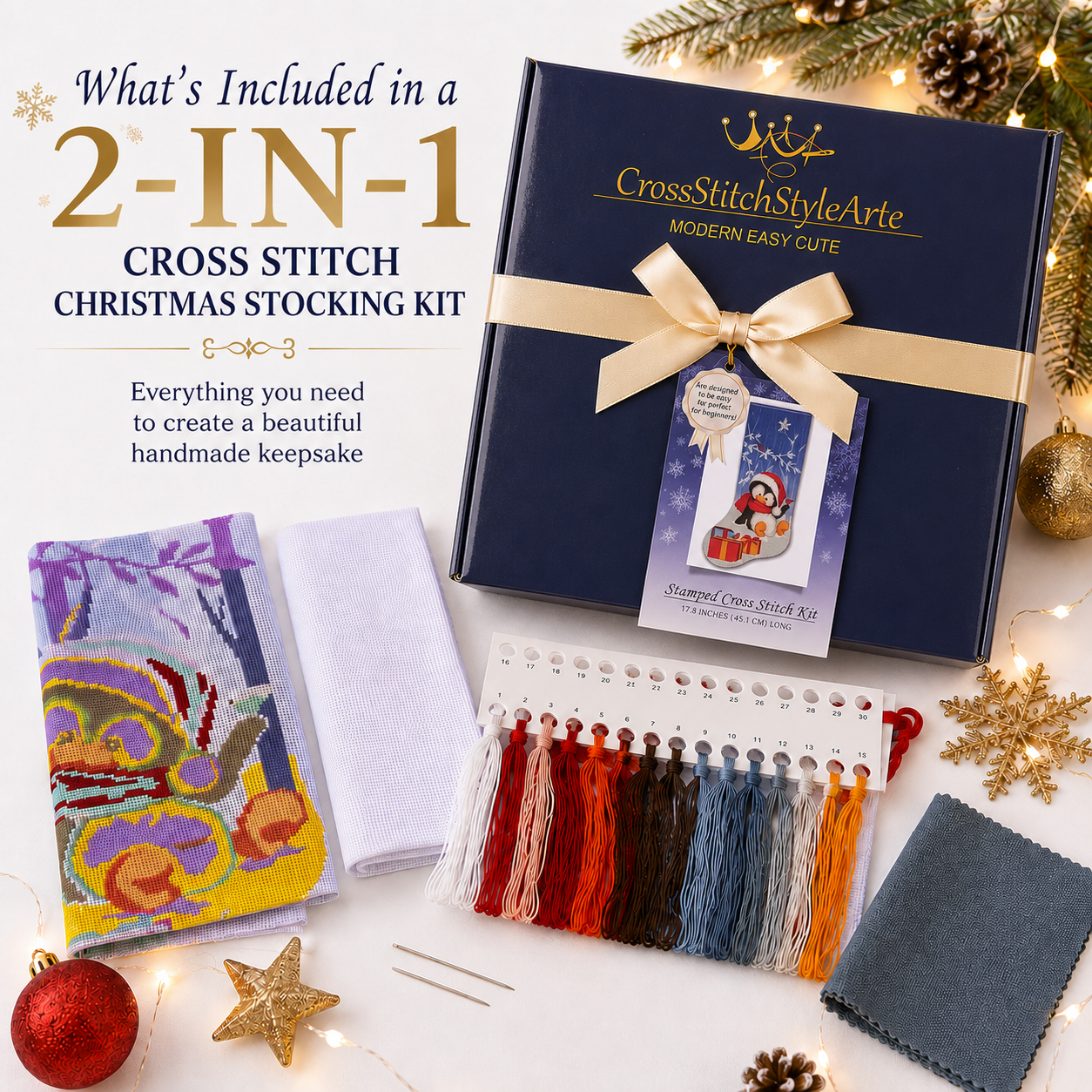
If you prefer having the fabric, thread, needle, pattern, and instructions prepared for you, explore our collection of cross-stitch kits.
You can also browse our instant-download cross-stitch patterns and choose a design you can start stitching today.
Happy stitching!