How Much Embroidery Floss Do You Need for a Cross-Stitch Project?
Running out of one thread color near the end of a cross-stitch project is frustrating. Buying far too many skeins wastes money.
Fortunately, you can estimate how much embroidery floss you need before you begin stitching.
The calculation does not have to be difficult. You need to know:
- how many stitches use each color;
- the fabric count;
- how many strands of floss you will use;
- which types of stitches are included;
- how much extra thread to allow for normal waste.
This beginner-friendly guide explains how to calculate embroidery floss for a cross-stitch project step by step.
Important: No method can predict thread use with perfect accuracy. Stitching tension, starting and finishing methods, travelling between stitches, and thread waste differ from one stitcher to another. The goal is to create a safe and practical estimate.
What Is a Skein of Embroidery Floss?
A standard skein of six-strand cotton embroidery floss, such as DMC Six-Strand Embroidery Floss, contains approximately 8 meters or 8.7 yards of thread.
The floss is made of six separate strands twisted together.
For most cross-stitch projects, you do not stitch with all six strands at once. You separate the floss and use only the number of strands required by the pattern.
For example:
- stitching with one strand gives you six usable single-strand lengths;
- stitching with two strands gives you three two-strand sets;
- stitching with three strands gives you two three-strand sets.
This is why one full skein can make far more than a few hundred cross stitches.
Why Thread Requirements Are Always an Estimate
Two people can stitch the same pattern and use slightly different amounts of floss.
Thread use changes because of:
- fabric count;
- number of strands in the needle;
- stitching tension;
- length of each working thread;
- starting and finishing methods;
- long jumps between separate areas;
- knots, tangles, and damaged thread;
- mistakes that must be removed and restitched;
- full crosses, half stitches, fractional stitches, and backstitch.
A calculator can provide a very useful estimate, but it cannot know exactly how much thread an individual stitcher will waste.
For this reason, always include a safety allowance.
Step 1: Find the Number of Stitches for Each Color
Begin with the thread or color key in your cross-stitch pattern.
You need the stitch count for each color separately.
For example:
- DMC 321 red: 1,250 full cross stitches;
- DMC 699 green: 720 full cross stitches;
- DMC Blanc white: 2,100 full cross stitches.
Do not divide the total number of stitches in the entire pattern by the total number of colors. Every color is used in a different amount and must be calculated separately.
What If the Pattern Does Not Show Stitch Counts?
Some digital patterns include the number of stitches beside every thread color. If your pattern does not, you can:
- check whether your pattern-viewing software shows a color usage report;
- use the statistics section of the PDF, if available;
- count the symbols manually for a small design;
- ask the pattern designer for a thread estimate.
For large patterns, software-generated stitch counts are much more reliable than manual counting.
Step 2: Check the Fabric Count
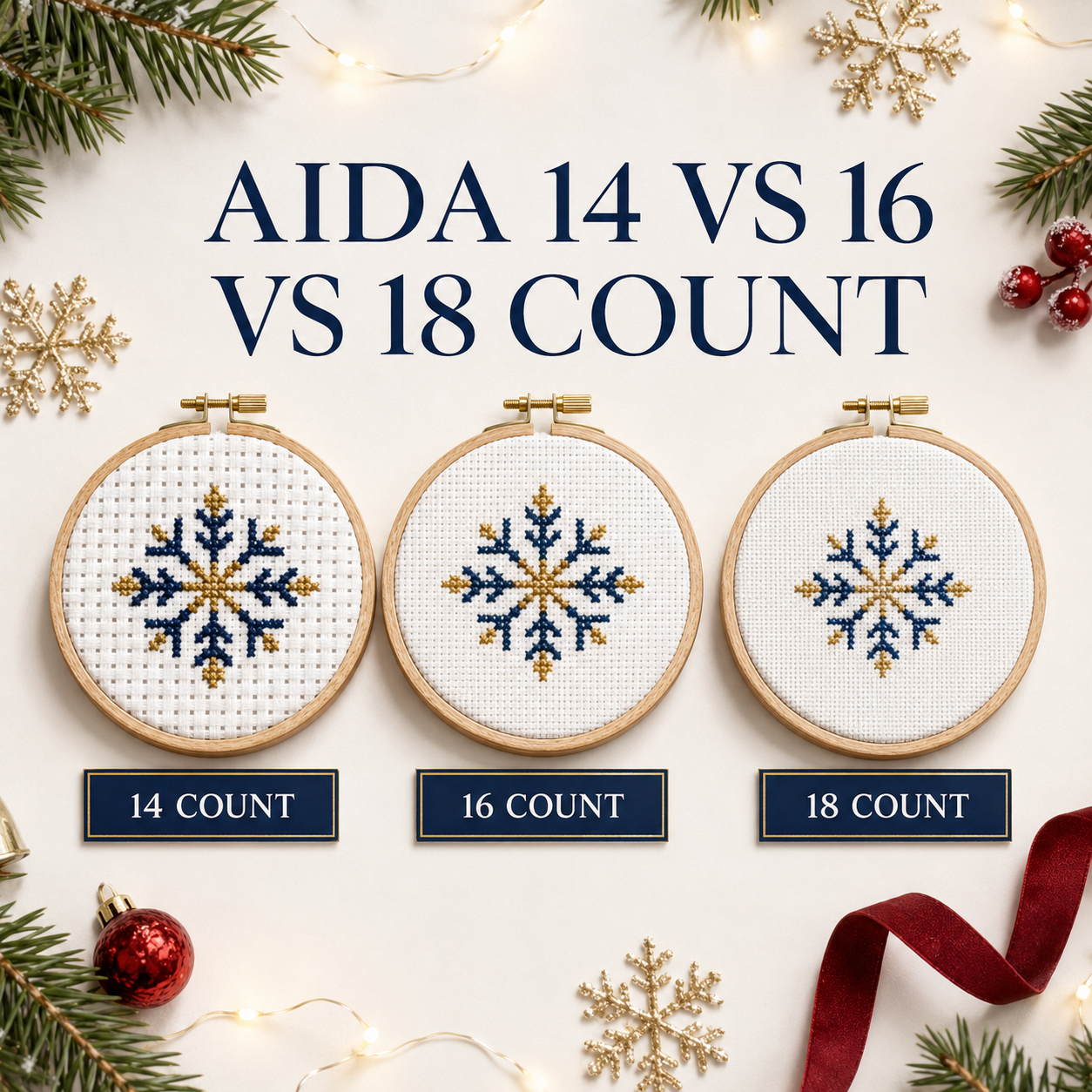
Fabric count tells you how many fabric squares or threads fit into one inch.
Common Aida fabric counts include:
- 11-count Aida;
- 14-count Aida;
- 16-count Aida;
- 18-count Aida.
A full cross stitch is physically larger on lower-count fabric and smaller on higher-count fabric.
Therefore:
- larger stitches use more thread;
- smaller stitches use less thread.
A design stitched on 11-count Aida normally needs more floss than the same design stitched on 18-count Aida.
Step 3: Check How Many Strands You Will Use
Your pattern should tell you how many strands of floss to place in the needle.
Common choices are:
- two strands for full cross stitches on 14-count Aida;
- two strands on 16-count Aida;
- one or two strands on 18-count Aida;
- one strand for many backstitch lines.
These are common practices, not fixed rules. Always follow the instructions included with your pattern.
Using three strands instead of two does not automatically require exactly 50% more skeins in real life, because waste and stitching methods vary. However, it will clearly use more floss and must be included in the calculation.
Step 4: Use a Practical Stitches-per-Skein Estimate
For easy planning, you can estimate how many full cross stitches one standard 8-meter, six-strand skein will produce.
The table below assumes:
- standard six-strand cotton embroidery floss;
- full cross stitches;
- two strands in the needle;
- reasonably efficient stitching;
- a safety allowance for starting, finishing, and normal thread waste.
| Fabric | Conservative planning estimate per skein |
|---|---|
| 11-count Aida | approximately 850–950 full crosses |
| 14-count Aida | approximately 1,050–1,200 full crosses |
| 16-count Aida | approximately 1,200–1,350 full crosses |
| 18-count Aida | approximately 1,350–1,500 full crosses |
These are planning estimates, not guarantees.
A design with many isolated stitches and long jumps on the back may use more floss. A compact block of stitches worked efficiently may use less.
Why Is There a Range?
The lower number is safer for:
- beginners;
- designs with scattered stitches;
- frequent color changes;
- long thread tails;
- loose stitching tension;
- projects where matching the same dye lot is important.
The higher number may be reasonable for:
- dense blocks of one color;
- short jumps between stitches;
- efficient starts and finishes;
- experienced stitchers with consistent tension.
When unsure, use the lower number.
Step 5: Calculate the Number of Skeins
Use this simple formula for each color:
Number of stitches for the color ÷ estimated stitches per skein = estimated skeins required
Then round the result up when deciding how many full skeins to buy.
Example: 300 Stitches on 14-Count Aida
Imagine that your pattern requires:
- 300 full cross stitches;
- 14-count Aida;
- two strands of floss.
Using a conservative estimate of 1,100 stitches per skein:
300 ÷ 1,100 = 0.27 skein
You need approximately one-quarter of a skein.
You would buy one skein, not two.
Example: 1,700 Stitches on 14-Count Aida
1,700 ÷ 1,100 = 1.55 skeins
Round up to the next whole skein.
You should buy two skeins of that color.
Example: 2,600 Stitches on 18-Count Aida
Using a conservative estimate of 1,400 stitches per skein:
2,600 ÷ 1,400 = 1.86 skeins
You should buy two skeins.
For a scattered design or a project with many mistakes and restarts, buying one additional skein may be sensible.
Step 6: Add a Safety Allowance
A thread estimate should include extra floss for normal waste.
A practical safety allowance is:
- 10% extra for dense, simple areas stitched efficiently;
- 15% extra for most ordinary cross-stitch projects;
- 20–25% extra for beginners or designs with scattered stitches and long jumps.
You do not always need to add this percentage separately if you already used the conservative lower end of the stitches-per-skein range.
Avoid adding a large safety allowance twice. That can cause unnecessary overbuying.
When Should You Buy an Extra Full Skein?
Consider buying an additional skein when:
- one color covers a very large part of the design;
- the calculation is close to a whole-skein boundary;
- the project includes large areas of dark or light background;
- the stitches are widely scattered;
- you expect to make and correct mistakes;
- the project may take a long time to finish;
- you want all skeins to come from the same dye lot.
For example, if your estimate is 1.92 skeins, two skeins may technically be enough, but purchasing three provides a safer margin.
If your estimate is only 0.25 skein, one skein is normally enough.
How Fabric Type Affects Thread Use
The most important measurement is the finished stitch size, not simply whether the fabric is called Aida, linen, or evenweave.
Aida Fabric
On Aida, one full cross stitch is usually worked over one fabric square.
Examples:
- 14-count Aida creates 14 stitches per inch;
- 16-count Aida creates 16 stitches per inch;
- 18-count Aida creates 18 stitches per inch.
Higher fabric counts create smaller stitches and usually use less floss per stitch.
Evenweave and Linen Stitched Over Two Threads
Evenweave and linen are often stitched over two fabric threads.
To find the equivalent Aida count, divide the fabric count by two.
Examples:
- 28-count evenweave over two is similar in stitch size to 14-count Aida;
- 32-count linen over two is similar to 16-count Aida;
- 36-count linen over two is similar to 18-count Aida.
Therefore, 28-count evenweave stitched over two generally uses approximately the same amount of floss per full cross as 14-count Aida.
Evenweave or Linen Stitched Over One Thread
When stitching over one fabric thread, do not divide the count by two.
For example, 28-count evenweave stitched over one creates 28 stitches per inch. Those stitches are much smaller than stitches on 14-count Aida and use less thread per stitch.
Always enter the effective stitch count into a thread calculator.
How to Estimate Different Stitch Types
Not every symbol in a pattern represents a complete cross.
Full Cross Stitches
A full cross consists of two diagonal legs.
Use the full-cross estimate from the calculator or stitches-per-skein table.
Half Stitches
A half stitch uses one diagonal leg instead of two.
It usually uses considerably less thread than a full cross. As a simple estimate, count one half stitch as approximately half of one full cross.
However, travelling on the back of the fabric and starting and finishing still use thread. A small number of isolated half stitches may use more than exactly half the amount.
Quarter and Three-Quarter Stitches
Fractional stitches vary in thread use.
For a simple and safe estimate:
- count a quarter stitch as approximately one-quarter to one-half of a full cross;
- count a three-quarter stitch as approximately three-quarters of a full cross.
When a pattern contains only a few fractional stitches, their effect on the total number of skeins is usually small.
Backstitch
Backstitch should not be calculated as full cross stitches.
Its thread use depends on:
- the total length of the backstitched lines;
- the fabric count;
- whether one or two strands are used;
- how often the line changes direction;
- how much thread is carried between separate sections.
For a design with only small details, the remaining floss from one skein is often sufficient.
For a pattern with extensive outlines or large amounts of black backstitch, estimate that color separately and allow extra thread.
French Knots and Decorative Stitches
A small number of French knots usually requires very little floss.
However, each knot also needs enough thread for starting, finishing, and handling. Do not try to calculate a few knots with mathematical precision. Include them in the safety allowance for that color.
Dense Stitching and Scattered Stitching
Two colors with the same stitch count may not use the same amount of thread.
Dense Blocks
A dense block of stitches is usually economical because the needle moves only a short distance between stitches.
Scattered Stitches
Scattered stitches can use much more floss because the thread travels across the back of the fabric.
Long jumps can also:
- show through light fabric;
- create loose threads on the back;
- make the finished work untidy;
- increase the risk of snagging.
When the next stitch is far away, it is often better to finish the thread and start again instead of carrying it across a long distance.
Both methods use extra floss, so scattered colors need a larger safety margin.
Does the Loop Start Save Thread?
A loop start is a convenient way to begin stitching with two strands.
It can reduce the amount of thread lost in the starting tail, but it does not cut the basic thread requirement in half. The finished crosses still contain two strands of floss.
Treat the loop start as a small efficiency improvement, not as a different calculation method.
Should You Round Every Small Amount Up to One Skein?
When buying new floss, thread is sold in whole skeins. Therefore, even a color requiring 0.10 skein means you need access to one skein of that color.
However, this does not mean the project will consume the whole skein.
For example:
- calculated use: 0.20 skein;
- quantity to buy: one skein;
- expected leftover: approximately 0.80 skein, minus normal waste.
Save and label your remaining floss. It can be used in future projects.
A Simple Thread Calculation Checklist
Before buying embroidery floss, check the following:
- Record the number of stitches for every color.
- Identify the fabric count or effective stitch count.
- Confirm how many strands the pattern requires.
- Separate full crosses, half stitches, and backstitch when necessary.
- Use a conservative stitches-per-skein estimate.
- Add a suitable allowance for waste.
- Round the final purchasing quantity up to whole skeins.
- Buy an extra skein when a major color is close to the limit.
Common Thread-Calculation Mistakes
Treating a Six-Strand Skein as One Working Thread
A standard skein contains six divisible strands. Forgetting this can make the estimate many times too high.
Assuming One Skein Covers Only 200–300 Crosses
On common fabrics, a standard skein used with two strands generally covers well over one thousand full crosses under normal conditions.
Ignoring Fabric Count
The same design uses more floss on lower-count fabric because each stitch is larger.
Ignoring the Number of Strands
A design stitched with three strands requires more floss than the same design stitched with two.
Treating Backstitch as Full Cross Stitch
Backstitch follows lines rather than filling complete squares. It should be estimated separately when it forms a significant part of the design.
Forgetting Long Jumps and Thread Waste
Scattered stitches, frequent starts, knots, tangles, and mistakes all increase thread consumption.
Adding Too Much Extra Floss Twice
Do not use a very conservative estimate and then add another large safety percentage unless the project genuinely requires it.
Frequently Asked Questions
How many cross stitches can I make with one skein of floss?
There is no single number for every project.
With two strands, one standard 8-meter six-strand skein may provide approximately:
- 1,050–1,200 full crosses on 14-count Aida;
- 1,200–1,350 full crosses on 16-count Aida;
- 1,350–1,500 full crosses on 18-count Aida.
Your result may differ because of tension, waste, stitch placement, and starting and finishing methods.
Is one skein enough for 300 cross stitches?
In most ordinary projects, yes.
For 300 full cross stitches on 14-count Aida using two strands, you will normally use only part of one standard skein.
How many skeins do I need for 1,000 cross stitches?
On 14-count Aida with two strands, one skein will often be enough for 1,000 full crosses. If the stitches are scattered or you expect significant waste, use a conservative estimate and check the calculator.
Does 18-count Aida use more or less floss than 14-count Aida?
It normally uses less floss per stitch because each cross is smaller.
However, a design that covers the same physical area contains more stitches on 18-count fabric. Always compare the same pattern and stitch count when estimating thread use.
Do I need to buy all the skeins at the same time?
For colors that require several skeins, buying them together is safest. Small shade differences can sometimes occur between dye lots.
Can a thread calculator guarantee that I will not run out?
No calculator can guarantee an exact result because it cannot measure your personal stitching habits.
A good calculator provides a strong estimate. Adding a sensible safety allowance greatly reduces the risk of running out.
Use the Free Cross-Stitch Thread Calculator
Manual calculations are useful because they help you understand where the estimate comes from.
For faster results, use our free Cross-Stitch Thread Calculator.
Enter:
- the number of stitches;
- the fabric count;
- the number of strands;
- your preferred safety allowance.
The calculator will estimate the amount of embroidery floss and the number of full skeins required for your cross-stitch project.
This helps you buy enough thread without purchasing far more than you are likely to use.
Final Advice
The safest way to calculate embroidery floss is not to rely on one universal number.
Calculate every color separately, account for the fabric count and number of strands, and add a reasonable allowance for waste.
Remember:
- small stitches use less floss per stitch;
- more strands use more floss;
- scattered stitches create more waste;
- one standard six-strand skein usually makes well over one thousand full crosses on common Aida fabrics when stitching with two strands.
A careful estimate takes only a few minutes and can prevent delays, mismatched dye lots, and unnecessary purchases later in your project.
Ready to Start Your Next Cross-Stitch Project?
Now that you know how to estimate the right amount of embroidery floss, you’re ready to stitch with confidence and avoid running out of thread halfway through your project.
If you’re looking for beautiful cross-stitch designs, explore our collection of Christmas stocking patterns, personalized cross-stitch patterns, and complete cross-stitch kits. Whether you prefer instant digital downloads or ready-to-stitch kits with carefully selected materials, you’ll find projects designed to make stitching enjoyable from the very first stitch.
👉 Browse our cross-stitch collection here:
Happy stitching!